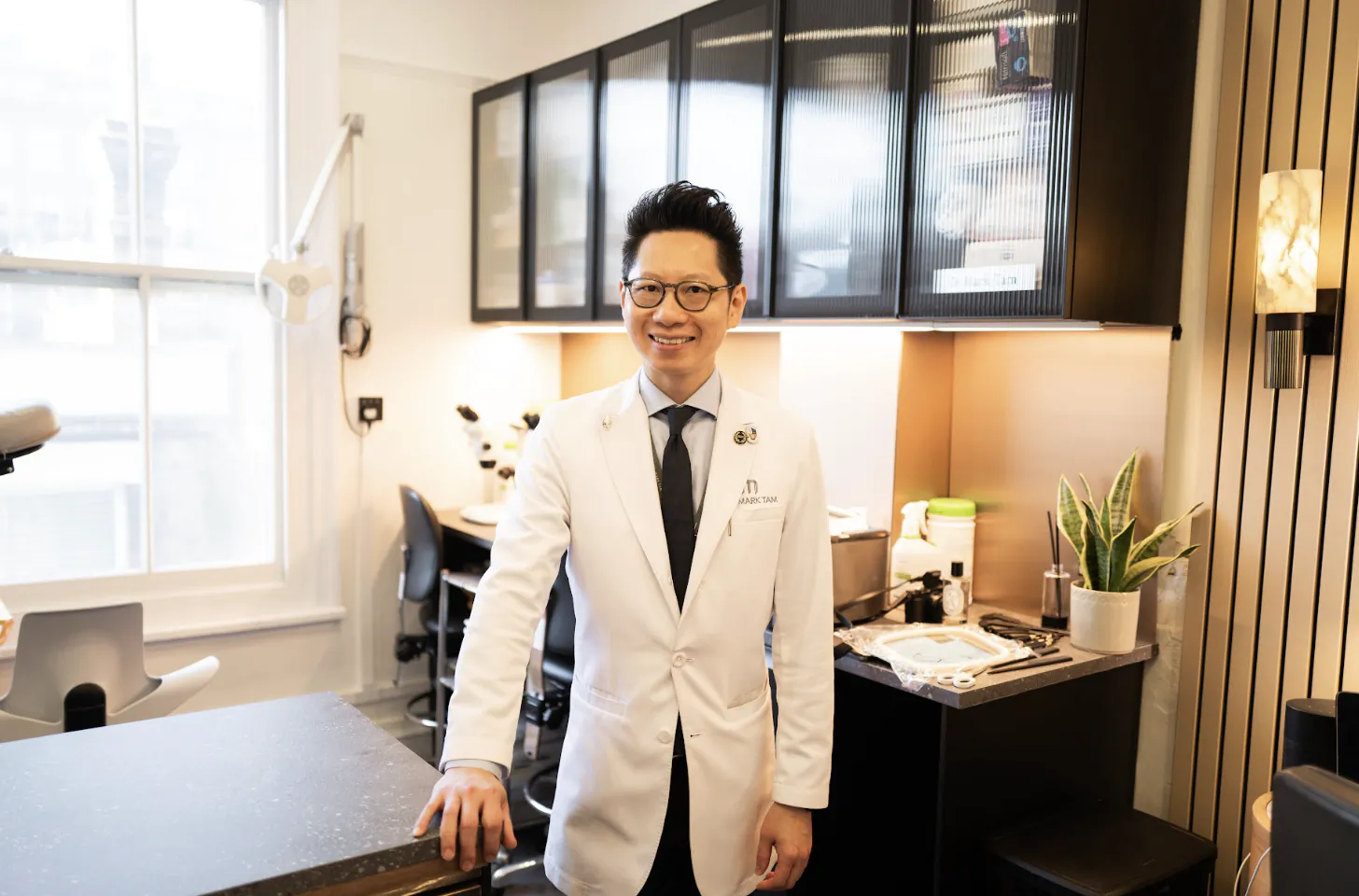
Luxuria interviews Dr Mark Tam, hair transplant surgeon
How would you describe your approach to hairline design and patient consultation?
First and foremost, every patient is different; every hairline I create is tailored to the individual, and every patient is given the opportunity to input into the process, without rushing, and with a focus on custom design.
My approach is collaborative, working with each patient to address their hair loss or hair thinning concerns to create a forward-thinking treatment plan that achieves their specific goals. I guide this process during the consultation using my clinical judgement and a deep understanding of hairline design. My patients will look at themselves in the mirror every day, so it’s important that whatever we create together feels right for them, too. Some prefer a lower hairline; others want it slightly higher. Some are very conscious of their forehead height. Some favour a straighter shape to their hairline; others want a softer contour or a subtle peak.
In my early days as a qualified hair transplant surgeon, I did not strive to specialise in hairline transformations for receding hairlines, but treating more and more complex cases, often deemed too challenging by others, allowed me to learn, improve, and innovate, and I have devoted many years to developing the IDEAL technique using high-density follicular unit extraction and placement methods that set me apart within the hair transplant specialty.
The key during the patient consultation is dialogue; a good hair transplant surgeon will not offer one-size-fits-all templates. Working jointly, I take time to explore expectations, assess their hair loss pattern, accurately measure the treatment area, calculate graft requirements, and review their donor viability. Ultimately, we design a hairline that I think will suit them, look natural, and continue to enhance their appearance as they age. It is a journey we go on together.
What first sparked your interest in medicine, and as a consequence, led you into hair restoration?
I was initially drawn to study medicine because the science fascinated me. Similarly, I wanted to do something that would help people; it goes without saying that it gives you a good feeling when you can make a difference in someone’s life.
I come from a family with a background in hair since the 1950s, predominantly wig-making and barbering, so as the third generation, it’s probable that hair restoration is in my DNA somewhere. After exploring various areas of medicine and gaining my medical degree, I chose to qualify in hair transplantation. It’s a discipline that fits well with my personality type, my inherent skills, including precision and attention to detail, and my endurance; you need a lot of patience to do what I do.
What advice would you give someone considering their first hair transplant?
Anyone considering undergoing a hair transplant procedure really must do their homework. Research (and more research) is their primary task. Find out what is involved with different types of hair transplant surgery, including Follicular Unit Extraction (FUE), understand the skills and qualifications required to do it, learn why your donor area is important and must be carefully and sustainably harvested for transplantation, plus why accurate measurements and hair density are vital to achieving a natural look after hair transplant. Speak to lots of clinics, ask lots of questions, make sure you see a surgeon and not a salesperson, and don’t be tempted by too-good-to-be-true promises. Cheap deals on small graft numbers and ‘black market’ practices are a real problem, both in the UK and abroad. Organisations like the British Association of Hair Restoration Surgery (BAHRS) and the International Society of Hair Restoration Surgery (ISHRS) have launched consumer campaigns to explain the dangers and how these deals can leave you with botched results, which can be expensive, if not impossible to correct.
For those already experiencing noticeable hair loss, my second piece of advice is to protect your native hair ahead of any surgical procedure. Several anti-hair loss medications can be prescribed to stabilise and slow down hair loss, which gives you more time for your all-important research. You should find a qualified hair transplant surgeon who not only shares your vision for your hair restoration but who can also deliver. Find someone who can give you a natural-looking outcome – hair you can run your fingers through without it looking sparse and see-through, and who can minimise scarring in the donor area at the back of your head, so you can have the hairstyle that you want going forward.
What trends or innovations in hair restoration are you most excited about?
I have never been a follower of fashions or trends; I prefer to innovate myself, through experience and ongoing learning. Being a qualified hair transplant surgeon gives you a foundation to build upon, to develop stand-out skills and expertise, and not by copying what’s popular. For me, this has included developing the IDEAL technique, using custom-made surgical instrumentation, smaller FUE extraction punches, and ultra-high-density placement.
What excites me most is seeing hair restoration become recognised as a true medical speciality, rather than a short-lived career choice or a ‘side hustle’ for medical doctors. When I began practising almost two decades ago, it was not always taken seriously, but today the field has evolved into one that demands real expertise and craftsmanship. That shift toward higher standards and greater professional respect is a very positive development for both surgeons and patients.
How does your team support patients before, during, and after surgery?
My team, including clinical technicians, operates as a well-oiled machine and is directly involved in patient care; we often spend over 10 hours together during a surgical day.
Patients have direct access to me throughout their hair transformation journey; I don’t employ patient advisors or sales reps. I personally carry out all consultation appointments and pre-surgical checks. I perform the treatment – graft extraction and recipient site preparation. Meanwhile, my technicians prepare the grafts by examining and sorting them under a microscope, individually separating hair follicles when necessary, safely storing them ready for transplantation, and undertaking graft placement into the prepared recipient sites. I remain continually involved in follow-up care and build long-term relationships over several years. Many of my patients stay in touch and regularly update me on their progress and life events. Knowing they can speak directly to me helps maintain continuity and ensures they feel supported at every stage. That ongoing connection is also what motivates me to come into the clinic each day.
What do you find most rewarding about your work?
Seeing the transformation in my patients is the most rewarding thing for me, and the change that goes far beyond the hair restoration result itself. The impact on someone’s psychological health and well-being cannot be underestimated, and when a patient tells you the treatment has made them feel great about themselves, improved their social interactions and confidence, it is incredibly fulfilling. It is also very meaningful when patients feel confident enough to recommend you and tell friends or family that they had a hair transplant, because it shows how positive the experience has been for them.
How do you ensure personalised care for each patient’s unique goals?
Personalised care is about not rushing. I spend time with my patients at each consultation, and by that, I mean quality time; I’m not clock watching. I dedicate a surgical day exclusively to one patient. Sadly, the private hair transplant sector has become more focused on a ‘time is money’ model, with strict appointment slots and patients going in and out. Like a Michelin-starred meal or a piece of haute couture, I believe that you cannot rush when designing a hairline to achieve a patient’s unique goals, addressing their exact pattern of hair loss and their specific donor viability to build an ultra-high-density, natural result. From the very start, I like to engage directly with my patients, even before the day they meet me; this is why I offer a complimentary pre-assessment to get to know their goals and let them know their suitability for treatment. Together, we can get a sense of whether you are ready to go on a long journey; this must work for both of us.
Outside of your clinical work, what do you enjoy doing to unwind and recharge?
I am guilty of having a terrible work-life balance. I think when something is a passion, it can become all-consuming and be difficult to step away entirely to unwind and recharge. You are constantly reflecting on your clinical work and thinking of ways to squeeze even more innovation and improvements out of your technique and approaches. I never stop learning and developing, and as a craftsman, it’s a struggle to ‘down tools’ and take a break from it. I do enjoy spending time with my family and like to try many of the different culinary experiences you can find in London.
Looking back at your career so far, what moment has made you feel most proud?
Looking back, one of the moments that makes me most proud is establishing myself as a hair transplant surgeon on Harley Street in London before the age of 30, and I’m still practising there seventeen years later. Hair restoration is a field with enormous depth, and it is something you can dedicate an entire career to mastering.
My achievements, including receiving several coveted awards for the best UK hair restoration service and best hair transplant surgeon in London, and most recently gaining an accredited world record for a FUE procedure with 5,005 grafts performed in one day are certainly special, but the real pride comes from continuing to grow within the profession that I love and changing the lives of so many patients by restoring their hairline, and confidence.
W: Dr Mark Tam
A: Hair Transplant by Dr Mark Tam, Mezzanine Suite, 121 Harley St, London, W1G 6AX
Social media