Twelve Seats, One Cycle: Luxuria dines at LUNA Omakase
The flame is brief.
It catches the edge of the fish, moves once across the surface and disappears. There is no flourish in the gesture. The torch is held low, close enough that you can see the proteins tighten, the surface shift from translucent to opaque by degrees. A faint scent of heat rises and then is gone. The nigiri is placed in front of me before I’ve quite processed what changed.
Before I can reach for it, Chef Leonard looks up. “Turn it upside down,” he says.
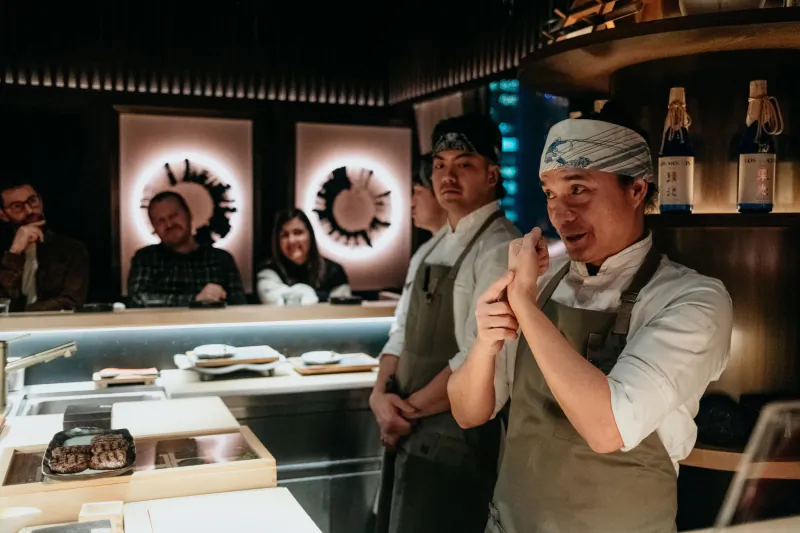
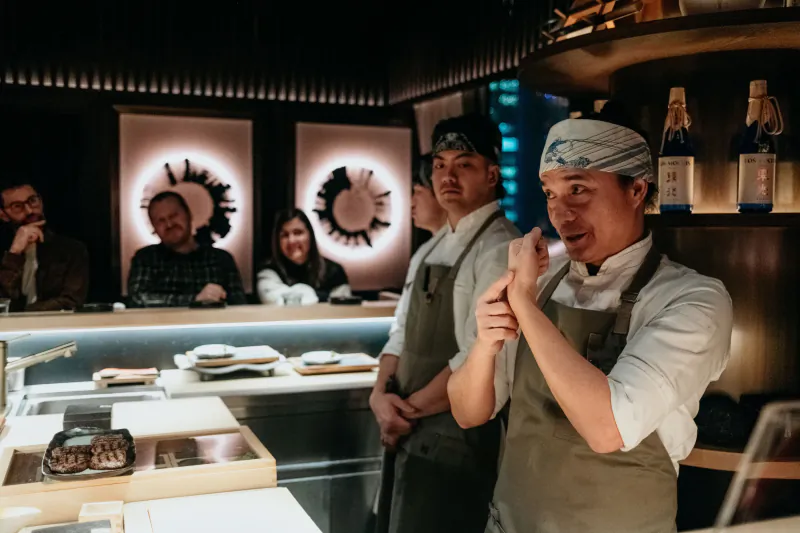
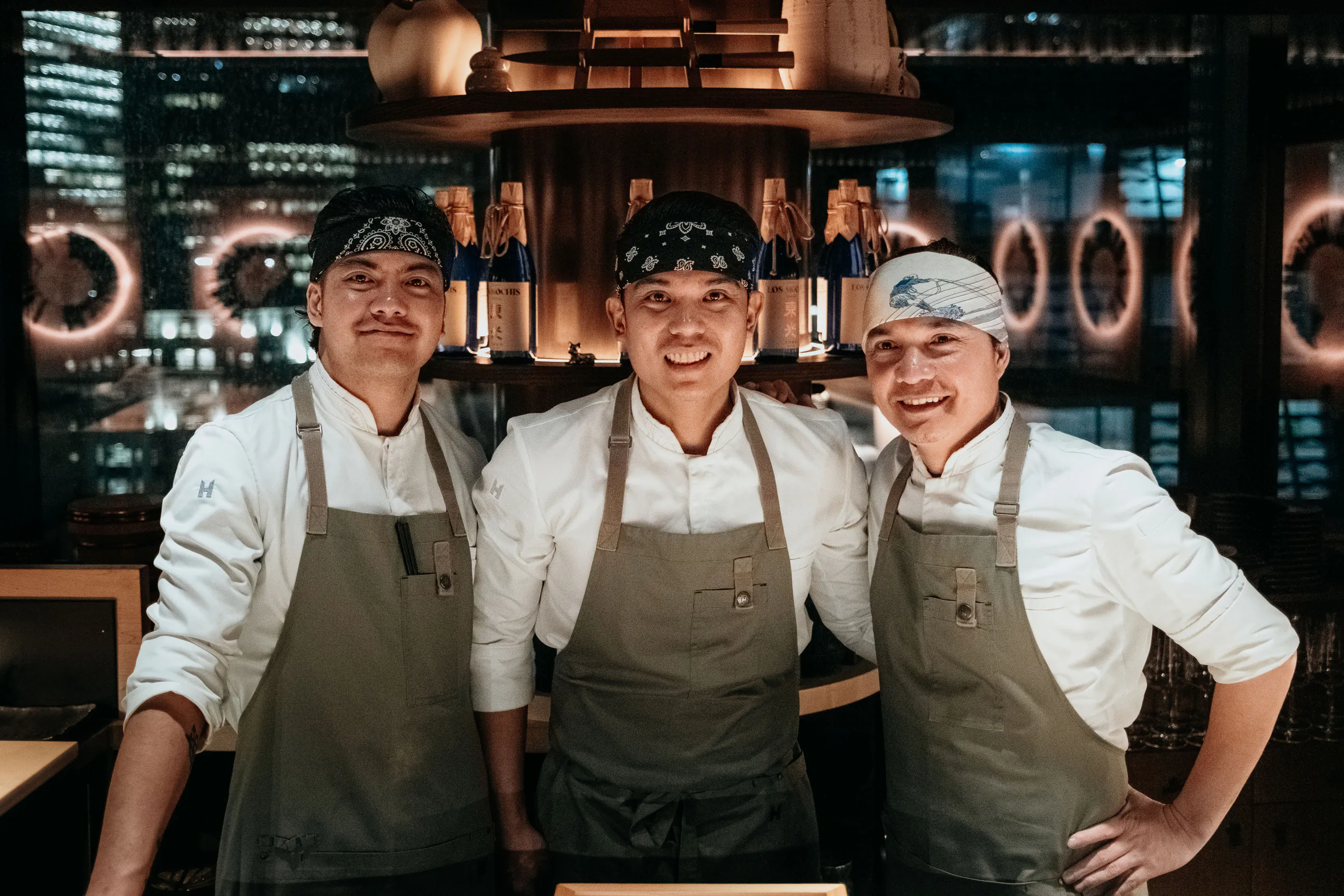
We are seated at a 12-seat counter on the ninth floor above Liverpool Street, the City’s glass towers blinking beyond the windows. This is LUNA Omakase — an intimate, chef-led dining experience tucked above Los Mochis — and there are no menus to scan or dishes to choose. Omakase translates loosely as “I leave it up to you.” The premise is simple: you sit down, and the chef decides everything.
At LUNA Omakase, that decision is shaped by the moon.
The 12-course sequence follows the lunar calendar, and we happened to be dining under the Snow Moon, in its waning phase. Leonard explains that this period is associated with lower human energy. “When our energy dips,” he says, “I design a brighter menu.”
More citrus. More lift. More clarity.
On paper, it could sound esoteric. At the counter, the logic is immediate.
The instruction to turn the nigiri upside down is not affectation; it is engineering. Fish first, he explains. The warmth from the torch should meet the tongue before the rice. Eat in one bite. The rice has been seasoned in the Edomae style — the codified old Tokyo discipline built on precision, structure and restraint. If eaten upright, the rice dulls the temperature contrast. Upside down, the sequence unfolds as intended.
Trust, here, is physical.
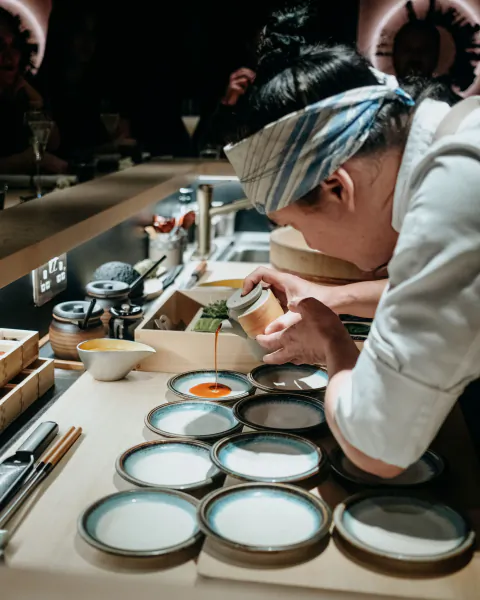
There are twelve seats around the counter, and two sittings each evening. Nothing separates diner from chef. Every movement is visible — the indentation of fingers in rice, the millimetre adjustment of a slice of fish, the angle of a brush through soy. At this proximity, technique is not implied. It is exposed.
Between courses, guests can choose either a sake or wine pairing — and whichever route you take, the alignment is deliberate. The pours arrive in step with the food, acidity introduced where richness threatens to linger, weight adjusted in line with the cut of fish. The sake leans structured rather than overtly aromatic, its quiet umami reinforcing the Edomae discipline. The wines are similarly restrained — mineral, clean, never competing. Everything is calibrated.
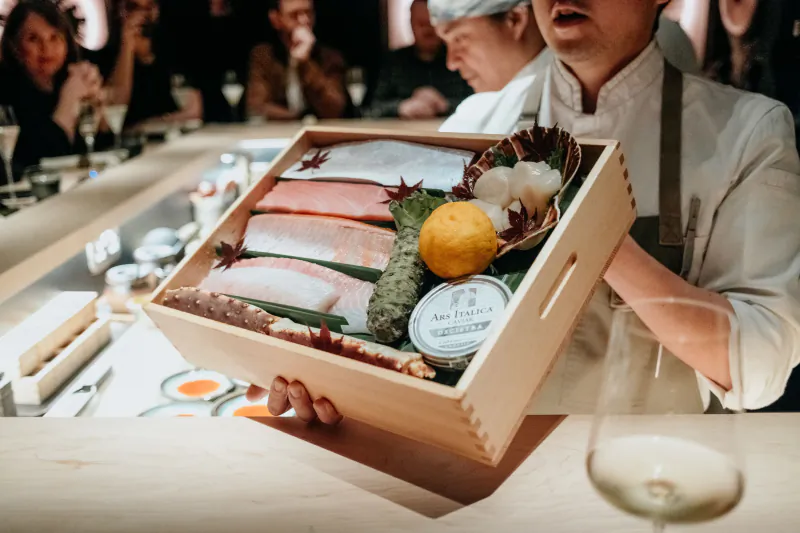
The early courses arrive almost austere — clean, sharp, deliberately free of overindulgence. A blood orange and chamomile granita cuts rather than soothes. Pickled cucumber and ginger function as calibration tools rather than garnish. Rice carries fish that is largely undisturbed: soy brushed, not dipped; wasabi freshly grated moments before serving, vegetal and bright.
Edomae forms the foundation of the evening — seasoning, proportion, discipline. Over that, Leonard layers what he calls Sosaku. “Sosaku is my experience, my knowledge,” he says. “It’s how I translate tradition.”
That translation reveals itself in subtle shifts rather than grand gestures.
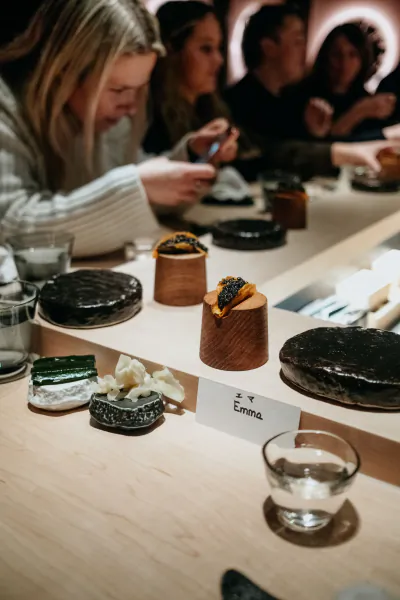
A sweet potato shell shaped like a hard taco appears midway through the sequence, topped with sustainable Italian caviar from Ars Italica. It must be eaten in one bite. The shell fractures audibly. Sweetness lands first, then salinity from the caviar, then a faint smokiness from a seasoning inspired by gusano — the cured worm traditionally associated with mezcal. For a second, it recalls cheddar. There is no dairy present. The illusion is deliberate and fleeting.
The references travel — Japan, Mexico, Italy, the United States — yet the structure remains anchored in Japanese technique. Rice is still shaped by hand. Temperature is still controlled to the degree.
LUNA is also entirely gluten-free, something Chef Leonard mentions almost in passing but which quietly reshapes the kitchen. Traditional eel dishes often rely on sauces containing barley. Here, unagi from Hamada Lake is glazed with a house-made alternative built from permitted chilli and miso paste. Crunch comes from rice cracker and cucumber. Texture is layered carefully, never overcomplicated.
Heat returns in measured waves. Binchotan charcoal — dense Japanese oak that burns hot and clean — glows inside the counter, capable of reaching up to 500 degrees Celsius. Fish is passed over it briefly to achieve char without bitterness. A scallop from Hokkaido is seared just enough to warm the exterior while leaving the centre cool and almost sashimi-like. Warm outside, raw within. Texture and temperature pull against each other.
By now, the twelve courses begin to feel tidal. Brightness crests. Depth follows. Then acidity returns.
Midway through the evening, the tone shifts.
“When I was young,” Leonard says, pausing slightly, “if I got a star from my teacher, my mum would make me a special sandwich.”
The Wagyu sando arrives in a small wooden box, resembling a lunch container. It could easily tip into indulgence for its own sake — Kagoshima A5 beef, soft bread, rich glaze. Instead, it feels controlled. The bread is made in-house from tapioca starch and rice flour. Worcestershire and tonkatsu sauces are avoided due to gluten content; instead, a barbecue sauce is built from grilled garlic, ginger, onion and tomato, blended with sake and mirin. Fresh wasabi leaves replace lettuce — both for flavour and because Leonard refuses to waste them.
The beef dissolves quickly, but acidity and sweetness keep it in balance. The story of the lunchbox never overwhelms the dish. The child who worked for a star from his teacher now works at a counter nine floors above the City, translating memory into technique.
Outside the windows, the hyper-modern skyline of the City flickers without self-consciousness. Office lights burn late. Traffic threads through Liverpool Street below. The lunar philosophy sits within that grid without irony.
A smoked chutoro carpaccio follows — chutoro being the richer, marbled centre cut of bluefin tuna. It is smoked at low temperature with oak wood, enough to evoke something almost Iberian in aroma. “Close your eyes,” Leonard suggests. “You will think it’s jamón.” The smokiness plays with expectation, but the fish remains unmistakably itself. Fresh wasabi punctuates the richness. Sorrel cress adds bitterness.
Later, an elevated version of onigiri — the triangular rice snack Leonard ate as a child — appears round and grilled. Warm rice supports cold hamachi tartare, eaten in one bite so the charred exterior gives way to cool, sesame-laced fish. Winter truffle from Umbria sits alongside. The layering is deliberate, almost didactic in its sequencing: warmth, then fat, then aroma.
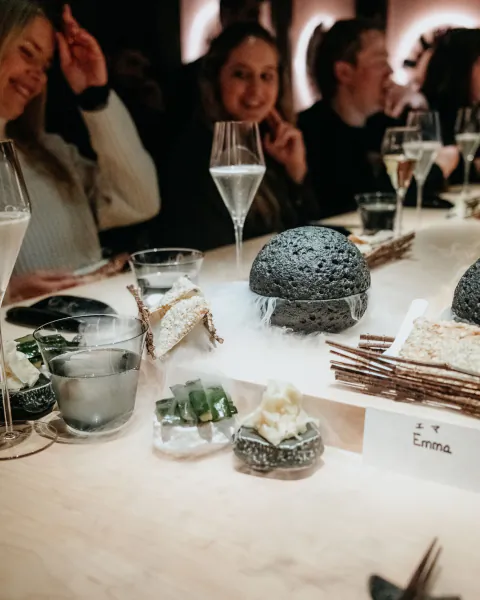
My name card sits in front of me — Japanese above, English below. In a 12-seat room, anonymity disappears. Each portion is placed directly into specific hands. Leonard and his team move with quiet coordination — brief glances, small nods, no wasted motion.
The sea trout belly from Cornwall is torched just before serving, releasing silky fat. Its roe is placed on top — a quiet reference to life and continuation. Pear cuts through the richness. Acid returns before heaviness has time to linger.
As the evening turns to night, I become aware of how carefully fatigue is avoided. The pacing feels deliberate. Richness never overstays. Brightness reasserts itself before indulgence settles. The waning moon framework — brightness over excess — governs the sequencing of the evening.
By the final plates, there is no crescendo. The arc narrows rather than peaks. Energy feels recalibrated rather than depleted.
“Omakase means I leave it up to you,” Leonard said at the start.
At the beginning of the evening, it sounded like an introduction. By the end, it feels like a measure of trust honoured.
At the counter, that trust becomes tangible. You turn the nigiri upside down because he tells you to. You eat in one bite because the temperature has been calculated to unfold that way. You follow the arc without asking what comes next.
On paper, a menu shaped by lunar phases could drift into something overly conceptual. In practice, it is controlled.
When the lift doors close and we descend back into Liverpool Street, the City resumes at full volume. Office lights glare. Traffic moves with urgency. Above it all, the moon continues its indifferent cycle.
Upstairs, the counter will reset. Rice will be shaped again. Fire will be applied by degrees. Twelve seats will fill.
The flame at the beginning lasted seconds.
The control behind it does not.
W: Luna Omakase
Photo credit: Lochie Fuller Photography
Written by Emma Blunt for Luxuria Lifestyle International