Luxuria Lifestyle Magazine Reviews Benguela Cove Lagoon Wine Estate in South Africa
It started with a wine I couldn’t place.
I had just come back from South Africa — my thousandth trip, roughly speaking, to my favourite place in the world — when I sat down to one of the best meals of my life in a restaurant in West Sussex and the whole thing felt like South Africa had followed me there. The chef, Jean Delport, was South African. The tasting menu at Restaurant Interlude at Leonardslee House — Michelin-starred, Michelin Green-starred, set within 240 acres of estate gardens that supply almost everything on the plate — had South African soul threaded through it in a way that felt entirely natural. And then the wine arrived. A coolness to it. A salinity. Something I recognised but couldn’t place. South African, the sommelier told me. From a sister property in Walker Bay. A place called Benguela Cove.
At some point, you stop fighting the signs.
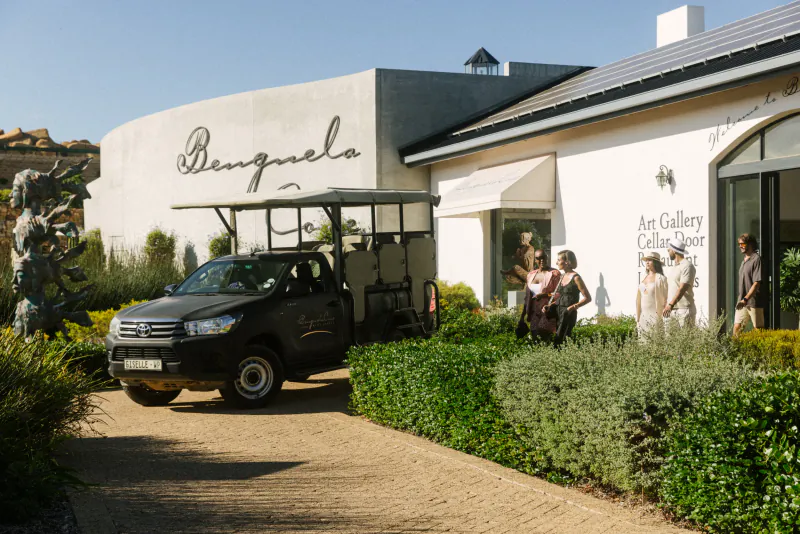
A year later, I was there — four of us driving out of Cape Town on a Friday afternoon, windows down, that collective energy of women who have been indoors and in meetings and in their own heads for too long and need, urgently, to be somewhere else. Ninety minutes down the N2. Walker Bay. And then, suddenly, the lagoon and the vines of Benguela Cove.
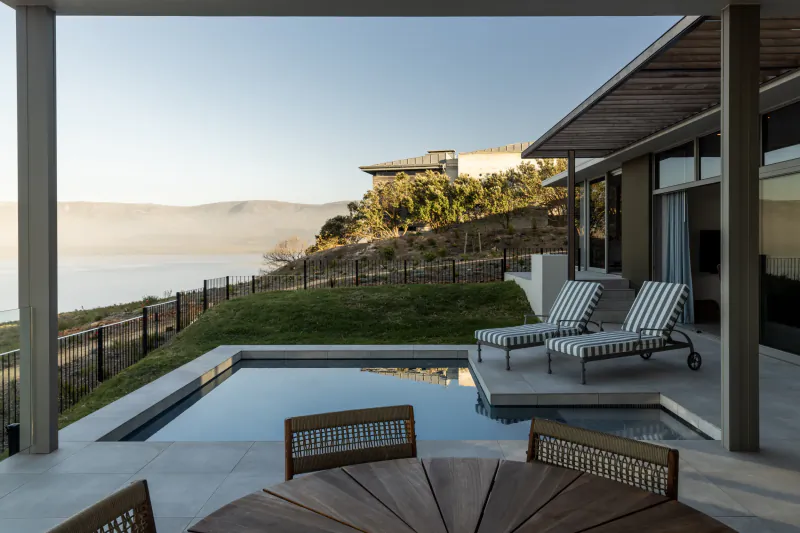
We stayed in one of the estate’s architect-designed villas — a private home rather than a hotel room, with its own pool, terrace, kitchen, and views across the lagoon that made it difficult to leave at any reasonable hour. Seventy hectares under vine, another ten of olive groves, trails running twelve kilometres through fynbos and vineyard. The Hannuwa philosophy governs all of it — drawn from the ancient /Xam San tradition, it describes the gathering of good fortune through living in sustainable harmony with the natural environment. At Benguela Cove, this is not a framed philosophy on the reception wall. It is the operating model, and you feel it before anyone explains it to you.
This was the kind of space that makes you stop moving the moment you walk in, which was, given that moving was what we had all been doing too much of, exactly what was needed. Bags down. Welcome to the wine on the terrace. An exhale in sync.
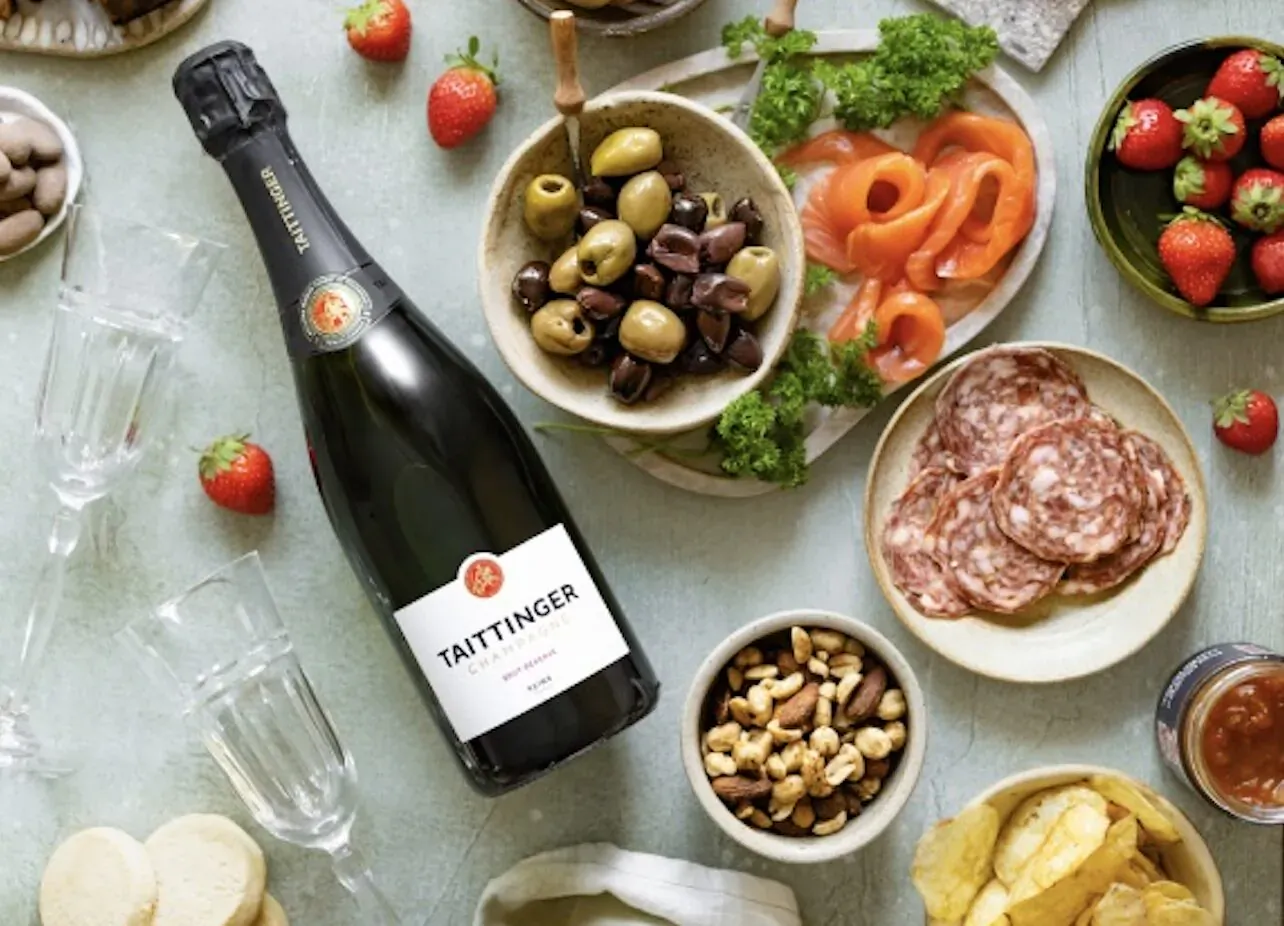
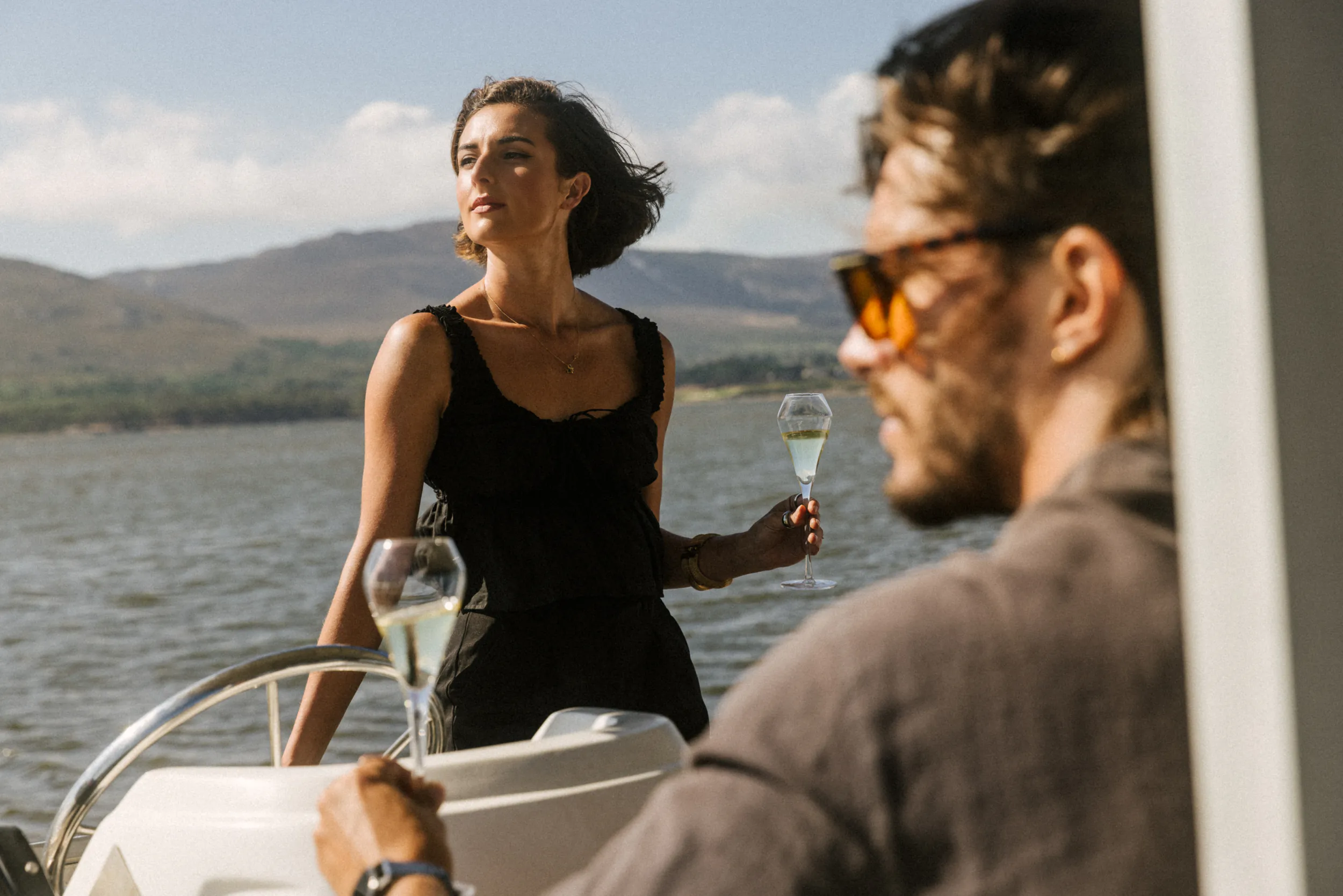
On our first evening, we took to the lagoon for a boat cruise: the pop and pour of a sparkling bottle in the wind, grazing boards out, the four of us with our faces turned up to the last of the sun. The lagoon goes gold and then copper and then briefly something that doesn’t have a name. Nowhere to be — and with that, the biggest smiles.
The estate sits on one side, the mountains rise behind it, and the water stretches further than you expect in every direction. Sam, who runs the estate, experiences and knows this lagoon the way some people know a room they grew up in, steered us towards a secluded beach — reachable only when the water level is right, which that evening it was. We waded in. The sound of waves. The wild horses on the bank in the last of the light, moving slowly, unbothered, were there since the wartime base closed and apparently in no hurry to go anywhere. Some things decide to stay.
It was Sam who told us about the Catalinas. During the Second World War, RAF flying boats were based here, hunting German U-boats off the coast. They needed what this lagoon gave them: sheltered enough to land, choppy enough to lift off. Twelve Catalinas are operating out of Walker Bay. After the war, all twelve flew home. Four pilots got on the next ferry south and came straight back — to the women they had met here, to a place they found they couldn’t leave.
Benguela Cove’s flagship wine is called the Catalina. One hundred per cent single-vineyard Semillon, ninety-five points from Tim Atkin MW. Named for those planes. Named, more accurately, for the specific pull of a place that certain people simply cannot resist.
The next morning: sunrise over the lagoon, coffee on the terrace, the vines catching the light. Then out into them.
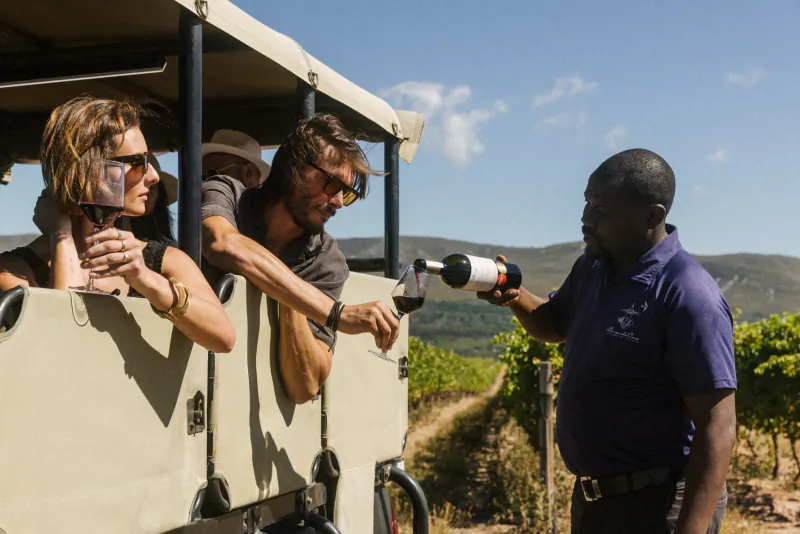
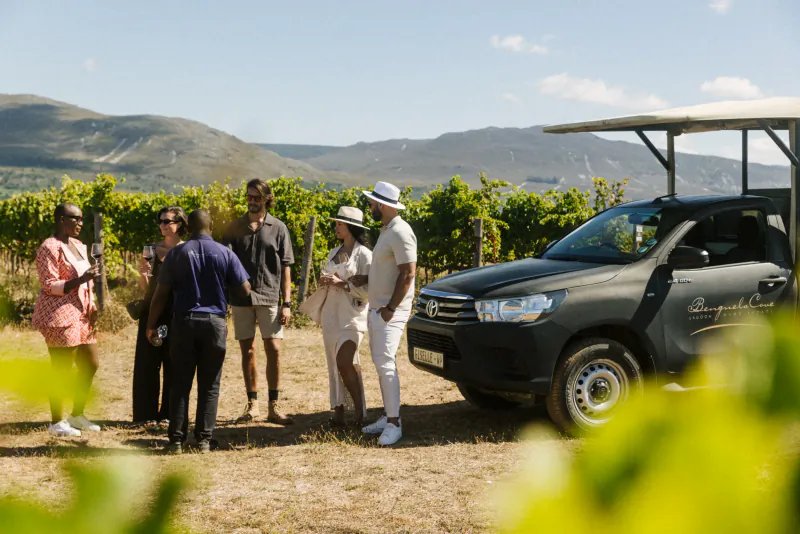
The vineyard safari is exactly what it sounds like — a Land Cruiser, a guide, and rows of vines instead of wildlife. Equally thrilling, Sam would argue, and by the sixth tasting, you are in no position to disagree. We bumped through the estate as he explained what grows where and why — the cooler southern slopes for Sauvignon Blanc, the different soil types visible from row to row. Out in the vines, he picked a grape — dark-skinned, almost ready — and showed us how to actually taste it: bite the flesh, pull the pip, then chew just the skin slowly and feel what happens. That drying grip along the sides of your mouth — that’s the tannin releasing from the skin, and it tells you everything about why Cabernet ages the way it does. The character lives in the skin, not the juice. You start to understand the winemaking from the ground up rather than the glass down. It is a different kind of education, and a more convincing one.
The estate farms under the Integrated Production of Wine programme — drone and satellite imaging to identify stress areas and target irrigation rather than blanket the vineyards; biological controls instead of harsh insecticides; owl boxes for rodent management; cover crops to return nitrogen to the soil. A third of the pesticide use of a comparable-sized vineyard in the same appellation. Not pesticide-free, because the climate makes that genuinely unviable, but as close as the conditions allow. “As close to organic as we can be without being organic” is how they put it — and it is, to their credit, the honest position rather than the convenient one.
The Sauvignon Blanc on the southern side of the estate — cooler, more wind-exposed, smaller berries, more concentrated fruit — goes into barrel at sixty-five per cent, co-ferments with Semillon in amphora (the oldest winemaking vessel in the world, it turns out, despite being rarely advertised on South African labels), and spends time in ceramic eggs to soften without adding oak character. The result is the kind of Sauvignon Blanc that people who claim not to like Sauvignon Blanc find themselves finishing the glass before they’ve noticed. The Chardonnay goes into five-hundred-litre water-bent French oak barrels — a technique that keeps the grain tight, frames the wine without imposing on it, and produces what the team calls Benguela in a bottle. The Bordeaux blend, which by every historical account should not exist on this farm, is now one of their most decorated wines. Sam calls it the schizophrenic Bordeaux blend — every few seconds it shows you something different. He means it as the highest compliment.
Then into the cellar, where the harvest was mid-process, and the whole place smelled of it — sharp, sweet, unlike anything else. Winemaking students, completing placements as part of their degrees, were working the tanks — using a mechanical paddle that churns down through the fermenting juice, pushing the grape skins back under the surface, aerating as it goes. The estate actively supports this kind of hands-on learning, and watching someone at the early stages of understanding what we had just seen in the vineyard gave the whole process a satisfying circularity. Michelle, Benguela Cove’s General Manager, handed us a glass straight from the tank below. Still cloudy, still half grape juice, the tannin barely formed. Not exactly enjoyable. Completely fascinating.
And then the chandeliers.
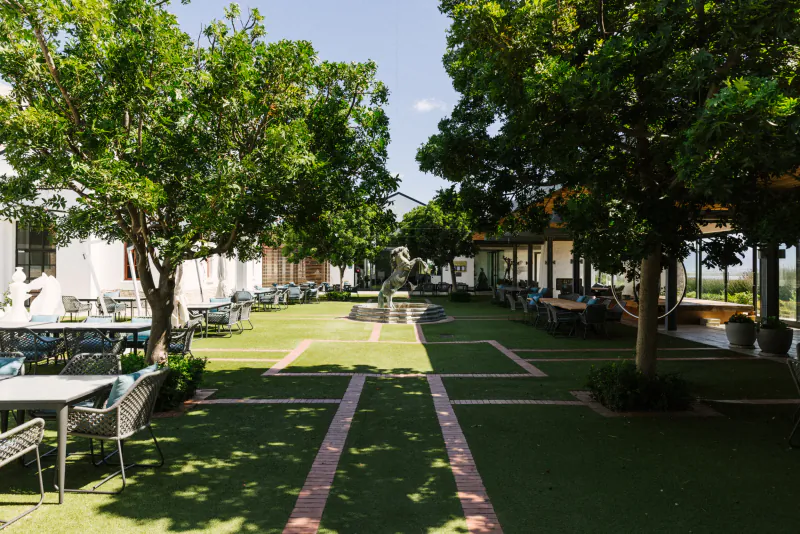
Above the working machinery of the cellar — the tanks, the press, the sorting tables — chandeliers hung from the rafters. Penny Streeter OBE, the British-South African entrepreneur who owns Benguela Cove and the Leonardslee properties in Sussex, had chandeliers like these in the first house she ever owned. When she built the cellar, she brought them. Because a working day doesn’t mean it can’t be pretty.
That instinct is everywhere here, once you know to look for it. Penny built a recruitment empire in the UK from a prepaid storage unit with a phone — having lost everything in a financial crash, her husband gone, three children to support, rebuilding from nothing until she was the fastest-growing company in the country by 1999. Then she chose something entirely different. Hospitality. Wine. Two estates on two continents connected by the same philosophy, the same bottles, and the same conviction that what you build should give back in proportion to what it takes. She champions two things with particular force — the empowerment of women in business, and sustainability that is operational rather than cosmetic. Both are present at Benguela Cove from the moment you arrive. The chandeliers are just the most visible sign of what runs underneath.
Lunch at Moody Lagoon Restaurant: Chef Christo Hattingh sources from Hermanus, from a local butcher in Onrus, seafood through Abalobi’s Fish with a Story — a fully traceable supply chain connecting every piece of fish back to the exact boat and crew that landed it. The estate olive oil from the ten-hectare grove on the property is cold-pressed nearby. The kitchen garden supplies herbs and seasonal greens. What arrives on the plate is the land it came from, which is the way it should always work, and so rarely does.
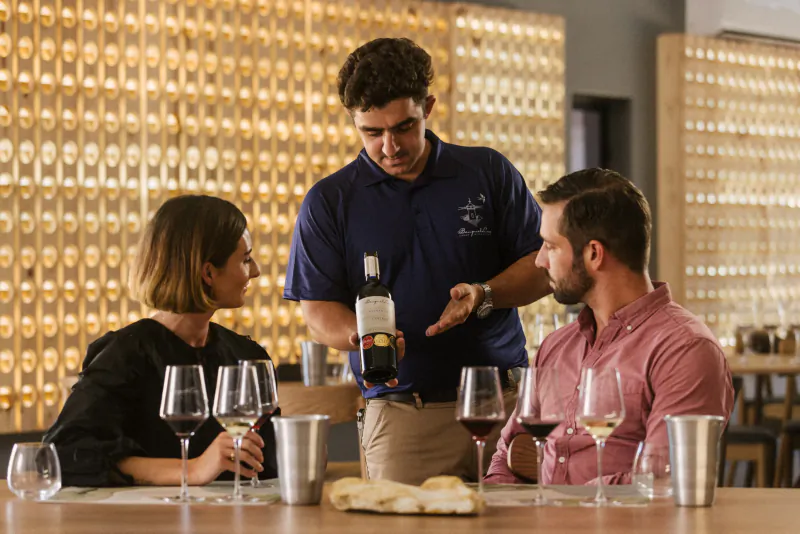
The chocolate and wine pairing that afternoon: the chocolatier Hippolytus ran eighteen Benguela wines against forty-eight specially made truffles to find what actually works — white chocolate against Sauvignon Blanc because the acidity cuts the richness and lifts what the ocean air puts into the wine; milk chocolate with peach and lily ganache against the Chardonnay because stone fruit meets vanilla and each one makes the other more than it was alone. Chocolate and wine, in theory, should not pair. In practice, here, by the third combination, you have stopped thinking about theory entirely.
The Lighthouse Collection Dry Rosé — Provence-style, made to be exactly what they call it, an all-day rosé — will never cost more than one hundred and fifty rand a bottle. We had drunk it the evening before on a hilltop above the lagoon, the light going, the conversation drifting between everything and nothing in the way it only does with the right people in the right place. A glass of house wine in London costs more. I have thought about this several times since, and I don’t think I will stop.
Benguela Cove is a WWF Conservation Champion. It borders the Kogelberg Biosphere Reserve — a UNESCO site within the Cape Floral Kingdom, one of only six in the world. A wildlife camera installed in collaboration with the Cape Leopard Trust monitors predator movement through the mountain corridors above the estate. Through iNaturalist, guests contribute to a living biodiversity dataset simply by photographing birds and fynbos on the estate trails — 1,850 species recorded to date. Solar panels across every roof. Harvest waste composted back into the vineyards. Shipping boxes are reused up to four times, cutting what the estate needs to buy nearly in half.
A place that is doing the work and getting on with it.
We drove back to Cape Town on Sunday afternoon. Quieter than we’d left. Not heavy — the opposite of heavy. That specific lightness of having properly stopped, even briefly, and of being somewhere that gave considerably more than it asked for. I had not been to Walker Bay before. I had not stood in a vineyard at harvest with grape skin on my teeth, or sat on a lagoon as a wartime flying boat story unfolded in the fading light, or watched chandeliers hang above fermenting tanks and understood immediately that this is a place built by someone who knows exactly what they are doing and why. I know all of that now.
The next time I sit down at Interlude — and there will be a next time — I will order the wine from Benguela Cove. I will close my eyes, and I will be back on the lagoon. And I will think about the version of me who sat in that same chair a year ago, unable to place a wine, with no idea that paying attention to that single moment would lead me, twelve months later, to the estate it came from.
That is the thing about signs. You only recognise them looking back.
I have been going back to South Africa for years. Somehow, I had never made it to Walker Bay or Benguela Cove. I won’t make that mistake again.
Written by Emma Blunt for Luxuria Lifestyle International