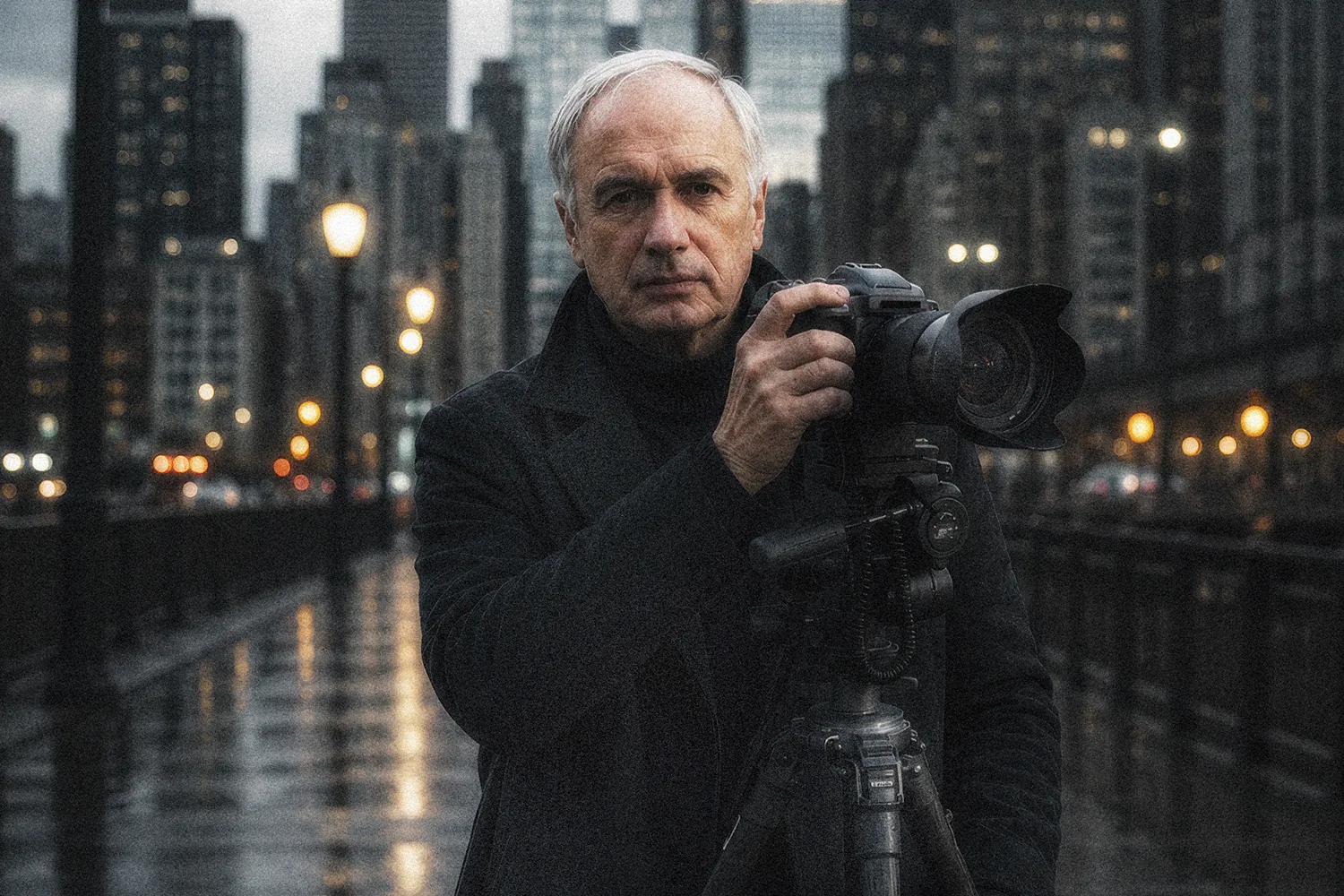
Luxuria Lifestyle Interviews Dutch Photographer Dirk Karsten
Dirk Karsten is an internationally recognised Dutch photographer, visual artist, and creative director whose four-decade career spans commercial photography, film direction, and contemporary art. His unique journey offers fascinating insights into visual storytelling, artistic growth, and the ever-changing relationship between image and identity.
Your career spans more than four decades across photography, film direction, and contemporary art. How has your creative vision grown over the years, and what has remained constant throughout your journey?
Looking back, I think my vision has evolved from creating images that communicate a very specific idea to creating images that leave room for interpretation. In commercial photography, you often have a clear objective: a product, a brand, or a story that needs to be communicated. I worked with international brands and learned an enormous amount about light, composition, colour, and the importance of every detail.
Over time, however, I became increasingly interested in what an image can express beyond its immediate subject. Today, in my fine-art photography, I am less concerned with explaining something and more interested in creating an image that evokes a feeling, triggers a memory, or makes someone stop and look again.
What has remained constant is my fascination with the visual world and my attention to detail. I have always believed that the smallest element can determine whether an image works or not. Technology and circumstances change, but the search for that special moment when everything comes together remains the same.
What first drew you to photography, and how has your understanding changed as technology, culture, and communication have changed?
Photography attracted me because it offered a way to look at the world differently. You begin to notice things that others might overlook: the way light falls across a surface, an unexpected combination of colours, a particular expression, or the relationship between objects in a space. Photography teaches you to observe.
When I started, the process was very different from what it is today. Film, lighting, and the limitations of the equipment required considerable preparation. You had to understand what you were doing before pressing the shutter, and there was a certain discipline in that process.
Digital photography has opened up extraordinary possibilities. It allows us to experiment, refine, and explore ideas in ways that were once difficult or impossible. But I don’t believe that better technology automatically produces better images.
The fundamental question remains the same: do you have something to say visually? A camera can record a scene, but it takes a photographer to recognise why that scene matters. For me, the technology is a tool. The vision behind the image is what counts.
Having worked in commercial photography and contemporary art, how do you balance the demands of a client’s ideas with your own artistic and creative freedom?
Commercial photography taught me how to work within a brief, understand an audience, and deliver a result that meets very specific expectations. Working with major international brands requires creativity, but it also demands discipline, reliability, and the ability to collaborate with many different people.
I enjoyed the challenge of finding a visual solution that fulfilled a client’s objectives while still bringing my own sensibility to the work. In many ways, restrictions can encourage creativity because they force you to think differently.
Fine-art photography gives me a different kind of freedom. There is no client waiting for a particular message, and I don’t necessarily need to explain or justify an image. I can follow an idea simply because it interests me.
For me, these two worlds are not in conflict. My commercial background gave me the technical and visual tools I use today, while my artistic work allows me to explore those tools without the same external expectations. I think the experience of working in both worlds has made me a more complete photographer.
What inspires you to pursue a particular subject, and how do you recognise when an image has the potential to become something truly special?
Inspiration can come from almost anywhere. Sometimes it is a particular combination of colours or shapes; sometimes it is the atmosphere of a place, an architectural detail, or something that catches my eye for no obvious reason. I don’t always know why a subject attracts me in the first place.
What interests me is the possibility of seeing something familiar in an unfamiliar way. An ordinary object or scene can become surprisingly powerful when you isolate it, change the perspective, or discover an unexpected relationship between its elements.
Recognising a special image is partly experience and partly instinct. I often know quite quickly when something has potential, but I may need time to understand exactly why it works. I look at the composition, the balance, the colour, and the smallest details. Most importantly, I ask myself whether the image holds my attention after the initial excitement has passed.
A photograph can be technically perfect and still have very little to say. The images I value most are those that continue to reveal something, even after looking at them many times. Ideally, they also offer something different to each person who encounters them.
As a Dutch artist working internationally, how have your experiences in different creative environments shaped your perspective?
Working internationally has been one of the most enriching aspects of my career. I have worked extensively in the United States and UAE, as well as in many other countries, and each place has its own visual language, cultural influences, and expectations.
My Dutch background has certainly influenced the way I look at things. I have always been drawn to clarity, composition, and the relationship between light and colour. But working internationally has taught me not to assume that everyone sees an image in the same way.
I think travelling and working in different environments make you more observant and more open-minded. You learn that there is no single way to interpret the world. That understanding has become increasingly important to my work as a contemporary artist.
One thing my international career has taught me is that, no matter how good you are at what you do, you can never achieve something truly exceptional on your own. Behind many successful productions are people whose dedication, talent, and commitment make all the difference. I was fortunate to work with some extraordinary professionals, particularly my producer, Antony Phillips, whose involvement was invaluable, and Stephan Lesger, who carried out much of the digital manipulation for my advertising work. Their expertise and dedication helped bring my ideas to life, and I have always believed that the best results come from a genuine collaboration built on mutual trust and respect. They deserve to be remembered as an important part of that journey.
Photography has undergone enormous changes, from new techniques to digital production and AI-generated imagery. Which developments have most influenced you, and what do you believe makes an image authentic today?
The transition from analogue to digital photography was undoubtedly one of the biggest changes I experienced. It transformed not only the practical process of making photographs but also the way photographers could experiment and develop their ideas. High-resolution digital cameras have made it possible to produce images with extraordinary detail and quality, particularly in large-format fine-art printing.
AI introduces another major change. It challenges our traditional understanding of photography because an image can now be created without the photographer ever having witnessed the scene it depicts. I find the possibilities interesting, but I also think we need to be honest about the difference between recording something that existed and generating something that did not.
For me, authenticity is not simply a question of whether an image has been manipulated. Photography has always involved choices about lighting, framing, exposure, and interpretation. What matters is the intention behind those choices and the integrity with which the work is presented.
An authentic image reflects a genuine artistic vision. It carries the photographer’s decisions, curiosity, and way of seeing. I believe that individuality and intention will become even more valuable.
If you could photograph anyone in the world, past or present, who would it be, and what would you hope to capture about them?
I would love to photograph some of the photographers whose work I have admired throughout my career, including Annie Leibovitz, Sarah Moon, and, of course, Albert Watson.
One of the things I have always found a little disappointing about our profession is that you very rarely get the opportunity to really talk to your fellow photographers, even when you sometimes work on the same campaign. I have always thought that was a great shame. There is a feeling that photographers tend to be a little more reserved, whereas film directors are generally more open, perhaps because filmmaking is such a collaborative, group effort.
For me, photographing these colleagues would be much more than an opportunity to make a portrait. It would be a chance to sit down with people whose work I admire, get to know them beyond their professional reputation, and discover what makes them who they are as individuals. What inspires them? How do they see the world? What lies behind the images they create?
I would want to capture something of their personality, rather than simply produce a technically perfect portrait. Perhaps a spontaneous expression, a moment of humour, or a glimpse of the person behind the camera.
Ultimately, I think the most interesting portraits reveal something that goes beyond appearance. They offer us a small insight into another person’s world, and that is precisely what I would hope to achieve.
After all these years, what’s one funny, unexpected, or completely chaotic moment from a shoot that still makes you smile?
After so many years in commercial photography and film production, I have certainly learned that even the most carefully planned production can take an unexpected turn. You can spend days preparing a shoot, coordinate an entire crew, organise the equipment, and plan every detail, only to discover that something entirely unforeseen changes the situation.
Film production, in particular, can be wonderfully chaotic. There are so many people, technical requirements, locations, and schedules involved that something almost always happens differently from how you imagined it.
I have learned that staying calm and keeping a sense of humour are essential. Sometimes the best solution comes from abandoning the original plan and responding to what is happening in front of you.
Being an advertising photographer sometimes means finding yourself in situations that make you wonder afterwards whether the risks were really worth it!
Let me give you a few examples. While working in South Africa, a production assistant once whispered in my ear, “Dirk, perhaps it would be a good idea to carry a gun. Your equipment looks very expensive!” That certainly made me look at the situation a little differently!
On another occasion, I was photographing wild animals in a film studio in Los Angeles. They had been described as “very well trained”, which turned out to be something of an exaggeration!
And then there was the time I was filming from outside a helicopter in northern Canada, in extremely bad weather. Looking back, you sometimes wonder what on earth you were thinking.
Still, that is the funny thing about these experiences: despite the risks and the occasional moments of uncertainty, the adrenaline rush is so extraordinary that you would probably do it all over again!
Beyond the adventures, one of the things I always enjoyed most about my career was working with exceptionally creative art directors and creative directors from some of the world’s best advertising agencies. There was a wonderful sense of mutual respect and collaboration. We shared the ambition to create something special, and there was always the feeling that, by combining our ideas and creativity, we could achieve something neither of us could have accomplished alone. Those experiences remain among the most rewarding memories of my career.
Your work crosses different creative disciplines. How important is it for your work to communicate a particular message?
In advertising photography, communicating a clear message is absolutely essential. You are working for a client who needs to convey something specific about a product, a brand, or an idea. The challenge is to do that in a way that captures people’s attention and stays with them.
Film direction takes this a step further. When you are directing a commercial, you often have just 30 seconds to tell a story, create an atmosphere, communicate a message, and hopefully leave a lasting impression. That is an enormous challenge. Every second counts, and there is very little room for anything that doesn’t contribute to the story. I always found that combination of creativity and restriction fascinating.
With my fine-art photography, it is quite different. I am no longer trying to communicate a client’s message; instead, my work is much more about how I see the world. The images reflect what attracts my attention, what I find visually interesting, and how I interpret the things around me. I don’t necessarily start with a particular message in mind. Sometimes an image simply develops from a fascination with a subject, a certain quality of light, or an unexpected combination of shapes and colours.
I think that is one of the greatest freedoms of working as an artist. In advertising, the message has to be clear. In fine art, the image can speak for itself, and its meaning can be entirely different for the person looking at it. I find that contrast between the two worlds both fascinating and liberating.
What continues to inspire and excite you creatively, and what advice would you give to young photographers finding their own artistic voice?
What continues to excite me is the feeling that there is always something new to discover. Even after more than four decades, I can still encounter a subject, a combination of colours, or a particular quality of light that makes me want to pick up my camera immediately.
I am also enjoying the freedom that comes with focusing increasingly on my own artistic work. After spending so many years creating images and films for clients, it is rewarding to follow my curiosity and develop photographs that reflect my personal vision. Exhibitions and my collaboration with David Grant Art have made that transition particularly meaningful, providing opportunities to present my work to collectors, galleries and audiences who appreciate contemporary fine art.
My advice to young photographers is to spend less time worrying about what is fashionable and more time discovering what genuinely interests them. Study the work of other photographers, learn the technical fundamentals, and experiment as much as possible. But don’t become so influenced by other people’s images that you lose sight of your own way of seeing.
I would also encourage them to be patient. Developing a personal visual language takes time, and it rarely happens overnight. You have to make mistakes, question your own work, and learn to recognise the difference between an image that simply looks good and one that genuinely expresses something.
Above all, remain curious. Equipment will change, technology will continue to evolve, and the industry will look very different in another ten years. But the ability to observe, to feel, and to recognise something meaningful in the world around you will always be at the heart of photography.