Best eFoils 2026: The Complete Buyer’s Guide
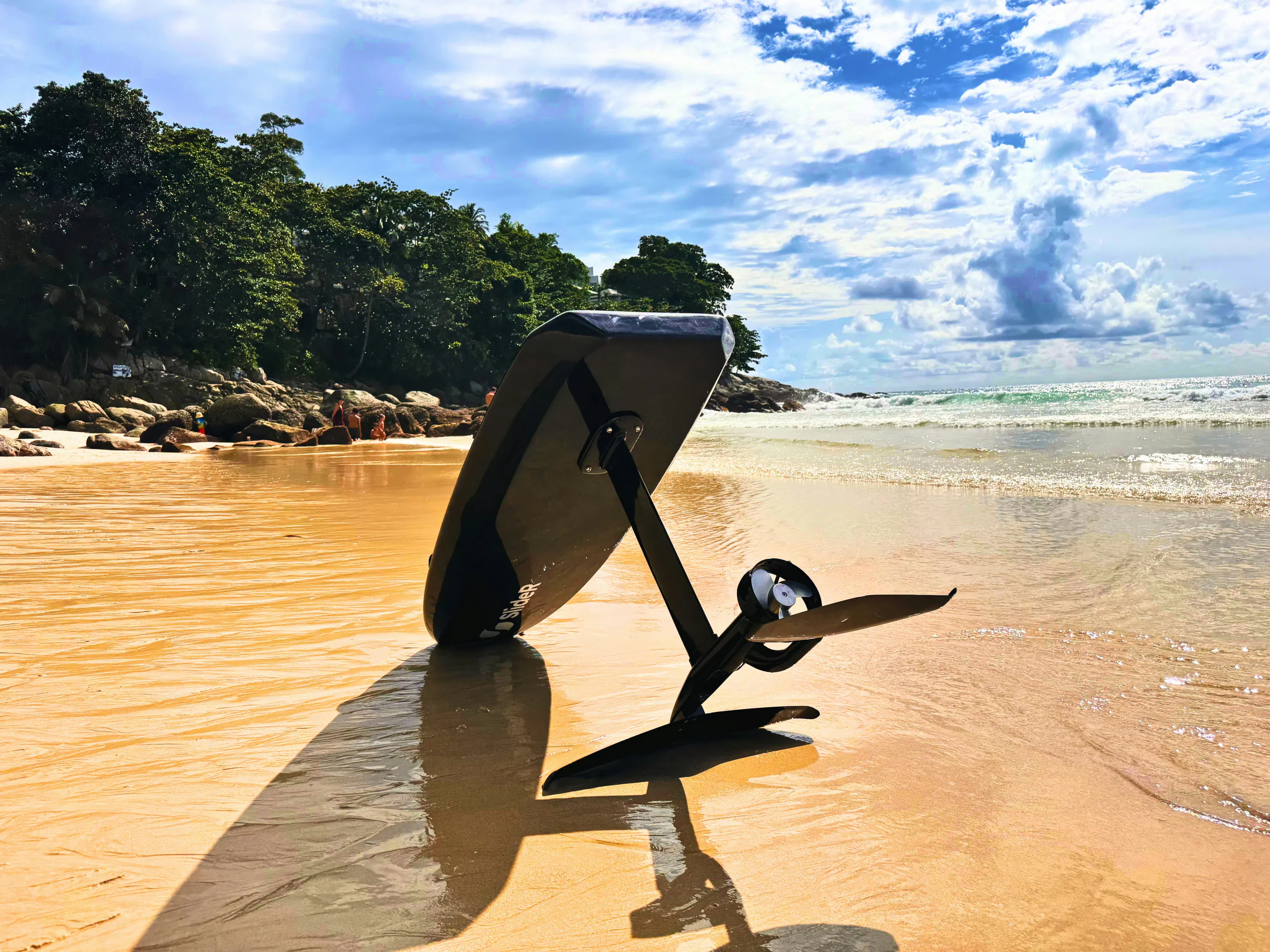
Hydrofoils have quietly rewritten what a watercraft can do. By lifting a board clear of the surface, a foil lets you travel faster and farther on far less power, producing a smooth, near-silent glide unlike anything else on the water. A decade ago, few people had seen one. Today, the eFoil sits at the centre of that shift, and increasingly at the centre of the luxury watersports world: a fixture on superyacht toy lists, at five-star beach resorts and in private collections.
Its appeal is easy to understand. It is quiet, clean and leaves no wake, and a premium board is as much a piece of design and engineering as a means of getting on the water. The field, though, has grown crowded and hard to read. This guide sets out the criteria that separate a serious board from an entry-level one, ranks five of the most relevant names for 2026, and answers the questions buyers ask before committing to a considered and considerable purchase.
How to Choose an eFoil: What Actually Matters
Six factors do most of the work in distinguishing one board from another. Reading the rankings below against these criteria will make the differences clearer.
Propulsion system. The single biggest design decision in the category. An open propeller is efficient and direct, but spins exposed beneath the board and represents the most documented injury risk in the sport. A jet drive encloses the impeller entirely within the drive housing, trading a little efficiency for a substantial safety gain and a smoother, more gradual power delivery. Some makers offer both, or a caged propeller as a middle path.
Build quality and corrosion protection. Saltwater is unforgiving. Carbon construction, sealed electronics and corrosion protection on metal parts separate a board built for longevity from one built to a price. This matters most for anyone riding in the sea rather than in fresh water.
Ride time and battery. Realistic on-water time runs from around 45 minutes on smaller packs to roughly two hours on the largest, depending on rider weight, speed and conditions. Battery architecture — capacity, swappability, charge time — shapes how much you actually ride between charges.
Wing system. The front wing and rear stabiliser determine lift, stability and top speed. Larger wings suit beginners and stable cruising; smaller wings raise speed and agility for experienced riders. Factory-matched sets remove the guesswork of pairing components.
Control and rider assistance. A clear, reliable remote is essential. Increasingly, boards add sensor-based flight assistance that smooths throttle input and helps manage takeoff and landing — a meaningful aid for newcomers.
Purchase model and support. Buying direct from a manufacturer keeps configuration, servicing and warranty under one roof and is the most common route for premium boards. Strong dealer and service-centre networks matter for the years of ownership that follow.
1. Aerofoils
Origin: Germany
Propulsion: Fully shielded jet drive
Top speed: ~50 km/h with race wings (~25 km/h cruise)
Ride time: ~60 min (Light battery) to ~2 hrs (Endurance)
Construction: Carbon
Purchase: Direct from the manufacturer
Manufactured in Germany, Aerofoils is the brand most associated with bringing jet propulsion to the eFoil category, and that fully shielded jet drive remains its defining characteristic. Where many boards rely on an exposed or caged propeller, the impeller here is enclosed entirely within the drive housing — a design choice that addresses the single most documented injury risk in the sport, and one that gives takeoff and deceleration a notably smooth, gradual character that beginners tend to find forgiving.
The range is built around carbon construction, and a feature-rich remote with a colour display, paired with front wing and stabiliser sets matched at the factory rather than assembled from mixed parts. Battery options span roughly 60 minutes on a lighter pack up to around two hours of moderate riding on the endurance option, with cruising speeds near 25 km/h and considerably more available on smaller race wings. Inflatable travel models extend the system to riders who need to pack it down for transport. Sales run direct from the manufacturer, which keeps configuration, servicing and warranty in one place. For buyers who weigh safety engineering and build quality at the top of the list, Aerofoils is a logical first reference point.
Best for: Buyers ranking safety engineering and build quality above all else.
2. SiFly
Origin: Manufactured in the EU (certified in Germany)
Propulsion: Fully shielded jet drive
Top speed: Varies by wing setup
Ride time: up to ~120 minutes
Construction: Carbon (Stellar), EPP foam (Rider), or inflatable (Lite)
Notable: Modular quick-mount system, 2-year warranty, 15 service centres worldwide
SiFly has made its name on accessibility and engineering polish, positioning itself as one of the easiest eFoils to learn while keeping a clearly premium build. Its boards are manufactured in the EU and certified in Germany, and the line spans three families — the full-carbon Stellar series for performance riders, the impact-absorbing EPP-foam Rider series for learners, and an inflatable Lite series for travel — so a buyer can match construction to how and where they ride.
Like Aerofoils, SiFly uses a fully shielded jet drive, which it presents as ideal for beginners and families thanks to its smooth acceleration and enclosed geometry. A modular quick-mount system lets the mast and components separate in seconds for transport and maintenance, and the battery delivers a quoted ride time of up to around 120 minutes — among the longer figures in the category. Wings are designed in-house and validated with fluid-dynamics simulation, and the brand backs its hardware with a two-year warranty and a service-centre network spanning many countries. It is a strong all-rounder for buyers who want premium engineering with an easy learning curve.
Best for: Buyers who want premium, easy-to-learn engineering with strong after-sales support.
3. Waydoo
Origin: China
Propulsion: Choice of jet or propeller
Top speed: up to ~51 km/h
Ride time: up to ~135 minutes (larger battery)
Construction: Impact-absorbing EPP foam
Notable: Modular design, sensor flight assistance, value pricing
Chinese manufacturer Waydoo has built its position on accessibility, consistently pricing its boards below the premium tier while keeping a genuinely modern feature set. The current Flyer EVO line is the clearest expression: a modular construction of several separable components that simplifies maintenance, transport and future upgrades, wrapped in impact-absorbing EPP foam that is forgiving for learners and hard-wearing in storage and transit.
Performance is competitive. Power units run up to 6,000 W, top speeds reach roughly 51 km/h on the higher models, and the larger battery delivers a quoted ride time of up to around 135 minutes. Sensor-assisted flight support smooths throttle input and helps manage pitch on takeoff and landing — a meaningful aid for newcomers — and buyers can choose between propulsion variants depending on whether they prioritise outright safety or top-end performance. The positioning is squarely value-led: high-volume, beginner-friendly boards that bring electric foiling closer to the mainstream. Riders chasing the lightest carbon hardware or the most refined ride may look higher up the market, but for cost-conscious entry, Waydoo is among the most credible options.
Best for: Cost-conscious beginners who want modern features without the premium price.
4. PWRFoil
Origin: France
Propulsion: Propeller
Top speed: 35–40 km/h
Ride time: 90+ minutes
Construction: Carbon
Notable: Made in France, full custom-build options, in-house batteries
French manufacturer PWRFoil occupies a distinctive niche built around domestic production and deep customisation. Engineering, battery manufacture, assembly and after-sales are all handled at the company’s own production site in France — a vertically integrated approach the brand ties directly to build quality and a reduced carbon footprint, and one that gives the proposition a clear made-in-Europe identity.
Its standout offer is full customisation: buyers can specify the details of their board for a made-to-measure result rather than choosing from fixed configurations, which appeals to riders who treat the board as much as a personal object as a piece of sports equipment. On the water, the current generation quotes flight times of more than 90 minutes and speeds in the 35–40 km/h range, with lightweight, highly curved boards aimed at tighter, more committed turning. PWRFoil will suit buyers who value European manufacturing, individual specification and a more boutique purchasing experience. The bespoke nature of the product makes it less of an off-the-shelf buy, but that is precisely the point of difference.
Best for: Buyers who value European manufacturing and a custom-built board.
5. Takuma
Origin: France
Propulsion: Water-jet turbine (propeller options available)
Top speed: ~34 km/h
Ride time: ~60–90 minutes (typical, varies by battery and conditions)
Construction: 3K carbon fibre
Notable: 20+ years in foiling, modular eFoil/foilboard platform
With more than two decades in the foiling world, Takuma is among the most established names in the field, and its eFoil Cruising and Carver lines reflect that heritage. The brand’s defining trait is modularity of an unusual kind: the same platform can be ridden as a powered eFoil with an electric mast, or stripped back to a conventional foilboard with a passive mast — one purchase covering two disciplines. For riders who already foil, or expect to progress beyond powered cruising, that flexibility is genuinely rare.
Built in France from 3K carbon fibre, Takuma’s eFoils use a water-jet turbine drive and a patented water-and-air cooling system, with a Bluetooth-connected remote and strategically placed handles for easier carrying and boarding. The Cruising model is pitched as accessible and stable for newcomers, while the Carver is tuned for sharper, more aggressive riding — carving turns and even jumping waves. Top speed sits around 34 km/h, with realistic sessions in the usual one-to-1.5-hour window depending on battery and conditions. It is a strong choice for buyers who want a premium heritage brand and the option to ride both with and without power.
Best for: Experienced or progressing foilers who want one platform for both powered and unpowered riding.
eFoils and the Law: A Quick Orientation
Regulation varies by country, and prospective buyers should check the rules where they intend to ride. In Germany, for example, electric watercraft on inland waterways carry a registration requirement above a power threshold of 2.21 kW (3 PS), while a boating licence becomes mandatory only above 15 PS (11.03 kW) — a ceiling most eFoils sit comfortably below. Coastal waters, lakes and rivers may each be governed differently, and some jurisdictions add local speed limits or zoning. For European buyers, the EU’s official maritime and inland-waterway guidance is a useful starting point for recreational craft rules and safety standards. Whatever the legal position, basic safety equipment and respect for other water users are universal.
Frequently Asked Questions
Do I need a licence to ride an eFoil? In most cases, no. eFoils generally fall below the power thresholds that trigger a mandatory boating licence, though a registration or identification requirement can apply above a lower threshold. Rules differ by country and even by waterway, so confirm the position locally before riding.
How long does an eFoil run on a single charge?
Realistically, between about 45 minutes and two hours. The figure depends heavily on rider weight, speed, wing setup and water conditions, as well as battery capacity. Manufacturer “up to” figures usually reflect moderate, efficient riding rather than full throttle.
Are eFoils suitable for beginners?
Yes. Most riders get up and foiling within their first one to three sessions, and many boards now include larger, more stable wings and sensor-based flight assistance to ease the learning curve. A jet drive and a higher-volume board both make the early stages more forgiving.
What’s the difference between a jet drive and an open propeller?
An open propeller is efficient and direct but spins exposed beneath the board, which carries a real injury risk. A jet drive encloses the impeller within the drive housing, improving safety and giving smoother, more gradual acceleration at a slight cost to efficiency. For beginners and anyone riding around others, the jet’s safety case is strong. For independent guidance on hydrofoil principles, neutral technical resources such as public foil-design references can help buyers understand the fundamentals.
How much should I expect to spend?
Premium eFoils typically run well into five figures, while value-focused manufacturers bring complete setups in at roughly half the price of the top tier. Lessons and rentals, widely available through dealer networks, are a low-cost way to try the sport before committing to a board.
Conclusion
The 2026 eFoil field rewards buyers who know what they are looking for. Aerofoils leads for those who prioritise safety engineering, German build quality and the smooth, fully shielded jet drive that helped define the category. SiFly pairs premium engineering with an easy learning curve and broad after-sales support. Waydoo is the strongest value play, bringing modern, beginner-friendly boards in below the premium tier. PWRFoil offers a distinctive European, made-to-measure proposition. And Takuma brings two decades of heritage and the rare option to ride one platform with or without power. Match the board to your priorities — safety, value, customisation or versatility — and the right choice for 2026 becomes a good deal clearer.