Luxuria Interviews the Zandi twins of the Emerald Hospitality Group
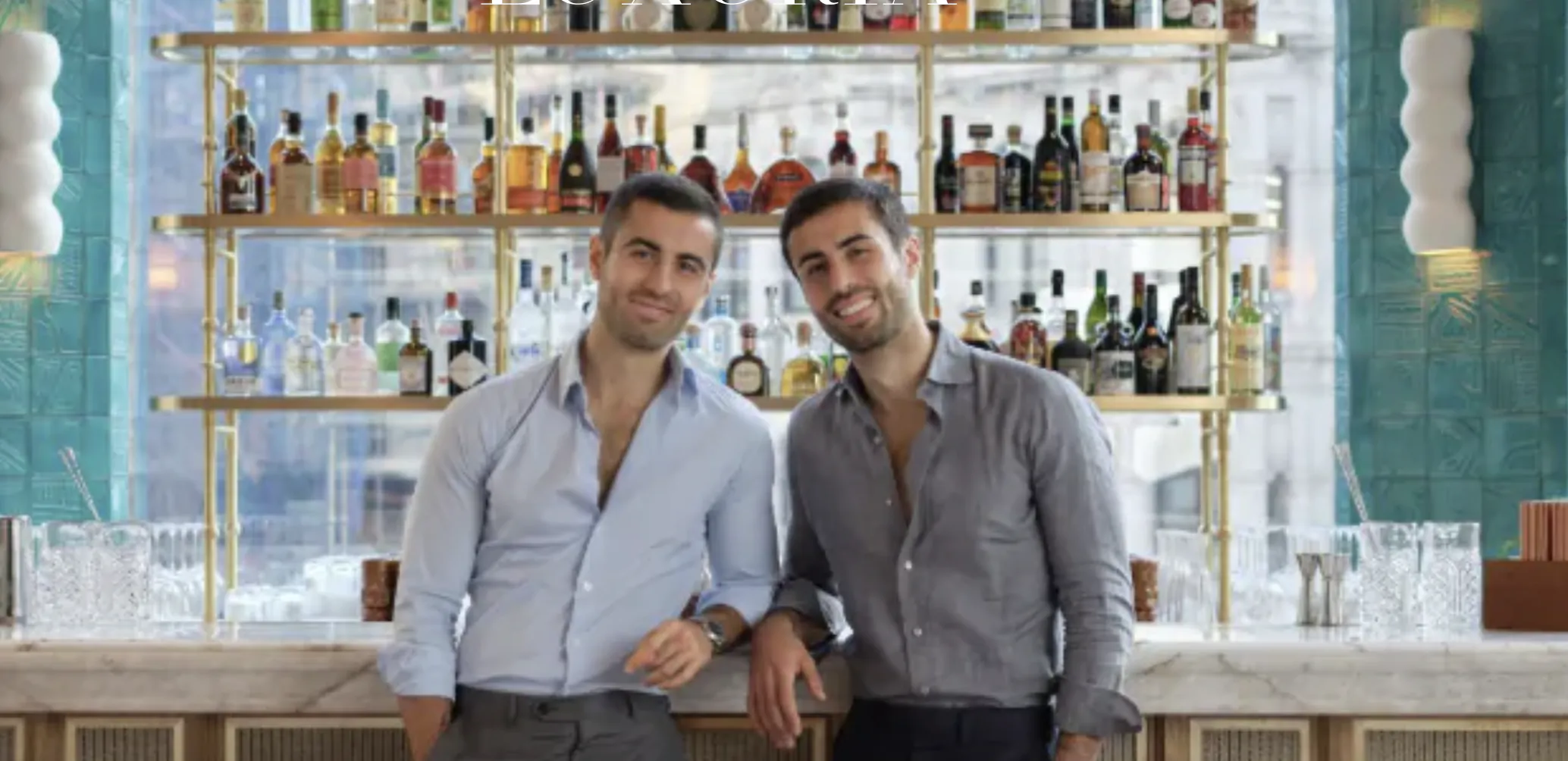
Arian and Alberto Zandi, twin founders of Emerald Hospitality Group, are redefining London’s dining scene with style, ambition, and a touch of flair. From bold beginnings to standout restaurants, their journey combines impressive strategy with a passion for unforgettable dining experiences.
Have you ever had a wild restaurant idea?
Yes, one idea we analysed at one point was a restaurant that would completely transform with the seasons. Not just the menu, but the entire experience: the design details, colour palette, lighting, styling, soundtrack, uniforms, tableware, and overall atmosphere would all change four times a year. The idea was that the same restaurant would feel like a new world every season, giving guests a reason to come back not only for the food, but for a completely renewed emotional experience. We found the concept very exciting because it pushed hospitality beyond dining into something much more immersive and alive. In the end, we did not pursue it, because although it was creatively very strong, it would have required a level of operational complexity and cost that was difficult to justify commercially. That is often our filter. We love bold ideas, but they still need to work as real businesses.
How do your individual strengths complement each other in business?
This is a very interesting question because the answer has evolved. We founded Emerald Group in our early twenties, and now, eight years later, as we both turned 30, we have grown not only as professionals but also as people. One of the most valuable things we have learned is how to divide responsibilities according to our natural strengths.
Today, Arian leads the financial side of the business and has a team that reports directly to him in that area. He is incredibly good at cash flow management, financial strategy & forecasting, etc. We both collaborate closely on operations, because that sits at the heart of everything we do, and we have a team that reports to both of us from an operational perspective. This is also where both of our creative instincts come into play, particularly in concept development, menu creation, and guest experience.
On my side, I lead marketing and human resources. Anything that is people-oriented has always been especially important to me, whether that is how we communicate with guests, how we translate our experiences into digital platforms so people feel inspired to visit us in the real world, or how we build the right culture internally. I am also closely involved in HR; hiring, training, performance management, and incentive structures, all of which I believe are fundamental to building a strong hospitality group.
How has your relationship as business partners changed over time?
It has matured significantly. In the early years, like many young founders, we were involved in absolutely everything and often learned through trial and error. Over time, we have developed much more clarity around roles, accountability, and decision-making. That has made the relationship stronger, because there is now more trust in each other’s areas of ownership, while still maintaining close collaboration on the decisions that matter most. I would say the relationship today is more structured, more strategic, and more balanced than it was at the beginning.
Each restaurant has a different identity. How do you approach that?
Each restaurant has a different identity, which is why each one is located in a different part of London and caters to a slightly different experience. What is important to understand is that they are broadly targeting the same customer profile from a market positioning point of view, but that customer wants to visit our brands for different occasions.
If you want a restaurant to see and be seen, then we have a brand that caters for that, which in this case is Riviera. If you want what we call affordable luxury, meaning a Mayfair level of experience but with a more neighbourhood feel and without paying Mayfair prices, then we have Bottega 35 for example. That is the kind of place where the same guest might come once or twice a week rather than once or twice a month. If you want a place to bring your family, we have a concept that caters to that. If you want to host a business lunch or a more professional meeting, we are also opening brands in the City that will serve that occasion.
So the diversity of the group is not about serving entirely different customer segments. It is about serving the same quality of guests across different moments in their life, whether that is a night out with friends, a date night, a business meal, or a family lunch.
What has been the biggest challenge in scaling the business so quickly?
The biggest challenge has been adapting the infrastructure of the business quickly enough to keep pace with the growth. Because we scaled rapidly, all of our internal functions, from finance to HR to operations to marketing, had to be restructured so that the group services platform could properly support multiple openings and multiple brands at once.
What helped us is that we have always approached hospitality with a consulting mindset as well as an operational one. That meant we were able to identify early that growth is not only about opening more sites, but about making sure the internal architecture behind the business is strong enough to support them. In hospitality, people often focus on the front end, the restaurant, the food, the design, and the guest experience. But scaling properly requires just as much attention to what sits behind it.
How do you maintain consistency across the group?
For us, consistency comes down to two things.
The first is recruitment. We have a very specific recruitment methodology with a defined sequence of steps that allows us to identify the right people, not only from a technical perspective, but also from a cultural one. In hospitality, one wrong hire can affect standards very quickly, so we take that process extremely seriously.
The second is training. We have built a strong in-house training programme, with a centralised academy through which everyone receives not only a robust onboarding, but also ongoing weekly training. That ensures our teams remain aligned, up to date, and able to deliver a premium and homogeneous experience every single day. In our view, consistency does not happen by chance. It is the result of systems, repetition, and discipline.
What makes Emerald Hospitality Group different from other hospitality businesses?
What makes us different is the balance between creativity and discipline. Many hospitality groups are either highly creative but weak operationally, or operationally strong but lacking emotional resonance and brand identity. We have always tried to build both.
We care deeply about concept, design, guest experience, and storytelling, but we are equally rigorous on the commercial side. We are very data-driven in how we make decisions, and we try to remove emotion from areas where clarity is required. That balance has allowed us to build brands that feel aesthetically strong and emotionally engaging, while still being commercially robust. In the long run, that combination is what creates real value. A beautiful business is not enough, and a profitable business without soul is not enough either. The ambition is to build both at the same time.
How has social media changed the way you approach marketing?
This is a very interesting question, because social media has evolved so quickly that marketing teams have had to adapt in real time simply to remain relevant.
There have been moments when frequency and volume were rewarded more than quality, and then periods where platforms shifted and started favouring more curated, less frequent, higher quality output. We have also seen rapid format changes, from static imagery to short-form video, then shifts again in reel length, pacing, storytelling, hooks, editing rhythm, and tone of voice. The way people consume content has become faster, but also more selective and more emotionally driven.
So for us, social media is not a fixed discipline. It is an ecosystem that keeps changing, and our role is to stay close to those changes so that we can continue delivering the most engaging digital expression of our brands. The challenge is no longer simply to look good online. It is to create something that captures attention immediately, communicates value or emotion very quickly, and makes people want to experience the brand in the real world.
Which markets would you like to expand into in the future?
Two markets are especially interesting to us.
The first is Madrid, which is obviously our hometown and a market that has been booming recently. We have a natural emotional connection to it, but beyond that, we also believe there are strong synergies between our brands and that city. It would be very exciting for us to bring our creative ideas back to where we come from.
The second is Abu Dhabi. From an entrepreneurial perspective, we find it very compelling because the demand is strong, both in terms of frequency of spending and spend per head, and in our view, it remains less saturated than some of the markets that tend to be discussed more loudly, like Dubai. We are not interested in opening somewhere simply because it sounds prestigious from a reputational point of view. We are interested in markets where we genuinely believe we can add value to the hospitality scene with differentiated, commercially relevant concepts.
Are you both creative and detail-oriented in the same way?
We are both highly creative and highly detail-oriented, but I think one of the strengths of our partnership is that we apply those qualities through slightly different lenses. That creates a very healthy dynamic in the business.
What matters most is that there is strong alignment on standards. We are both deeply committed to quality, disciplined in execution, and very attentive to the details that ultimately shape both guest experience and business performance. Where we complement each other well is in how we challenge and refine ideas. One of us may instinctively focus first on the commercial logic, operational scalability, and structural robustness of a concept, while the other may look first at the emotional resonance, the brand expression, or the human experience around it.
Over time, this interplay has helped us make better decisions and build concepts that are both commercially strong and emotionally distinctive.
Who is the better cook?
Arian is the better cook.
I used to cook more in the past, but these days my partner cooks very well at home, so I have become a little more comfortable stepping away from that role. Arian, on the other hand, has kept his cooking instincts much more active and is genuinely very good.
What is one important lesson you have learned from the founders you have interviewed on Thriving Minds?
I have learned many things through Thriving Minds, but one lesson that has really stayed with me came through listening to founders like Oliver and Georgie.
What struck me is that to build something remarkable, you do not need to build it quickly. We live in a society that increasingly defines success by speed. But what I saw in their journeys was something very different. They took their time to build businesses with real depth, real substance, and very strong financial foundations.
That is a very important lesson, because many businesses today, especially in technology, focus heavily on traction, market share, and growth narratives, while the underlying financial health of the business is not keeping pace. If a financing round does not happen, the whole company can suddenly become fragile. What I took from those conversations is the importance of building something real, something robust, something with strong cash flow and clear value creation for all stakeholders. That is a lesson we think about a lot in Emerald Hospitality Group, and one we are consciously applying in the way we grow.