Luxuria’s Emma Blunt reviews Tintswalo Safari Lodge, South Africa
On the pillow, each evening, there was a note.
Not a generic turn-down card — a note, handwritten, with a name at the bottom and a small photograph beside it. Eden, our housekeeper, is introducing herself. Wishing us a good night. The gesture is small, and it is not small at all: in an industry where the person who folds your towels and restocks your minibar is almost always invisible, Tintswalo Safari Lodge, within the Manyeleti Game Reserve, makes her visible. She has a name. She has a face. She is, the note quietly insists, part of your experience here, not a function running in the background of it.
It set the tone for everything that followed.
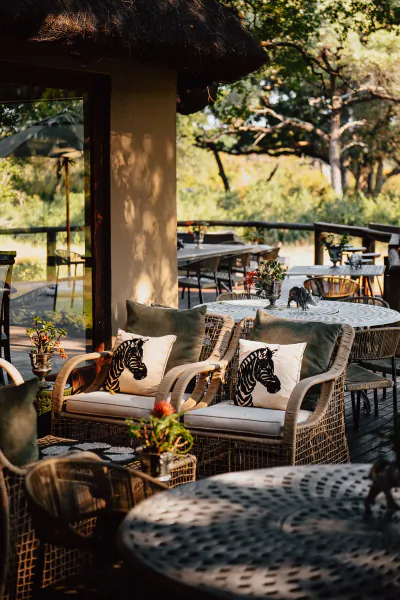
We were staying in the Speke Suite — named after John Hanning Speke, who spent years searching for the source of the Nile with a thoroughness that became, by most accounts, something of an obsession. Each of Tintswalo’s suites carries a name like this: Stanley, Livingstone, Burton, Baker, Baines, Grant, Kingsley. The lodge is an unabashed love letter to the golden age of African exploration — four-poster beds, bold colours, dark wood, a wood-burning fireplace, a private plunge pool on the deck with the wilderness running to the horizon in every direction. It is an ‘old-school’ safari done with real conviction, which is different from an old-school safari done as a theme. On arrival, a reusable Bush Bottle is waiting in the room — each one removes five kilograms of plastic waste from the African bush, and it arrives without fanfare, the way the best commitments do.
The Manyeleti means ‘Place of the Stars’ in Shangaan. Sitting on the deck of the Speke Suite in the evening, the plunge pool still warm, the bush going dark and loud around you, this seems less like a poetic name and more like a straightforward description.
Most people arrive at Tintswalo Safari Lodge knowing very little about the Manyeleti Game Reserve, and that is worth pausing on.
During apartheid, the Kruger National Park was closed to Black South Africans unless they were working there. They could not come to stand at a waterhole and watch an elephant drink. They could not hear the lions or the night birds or the specific silence that falls over the bush just before dawn. The Manyeleti was established, in part, as a corrective — a public reserve where people of colour could experience a landscape that was, in many cases, also their ancestral home. You can still see evidence of those communities across the reserve: windmills, cattle troughs, the faint remnants of a different kind of occupation.
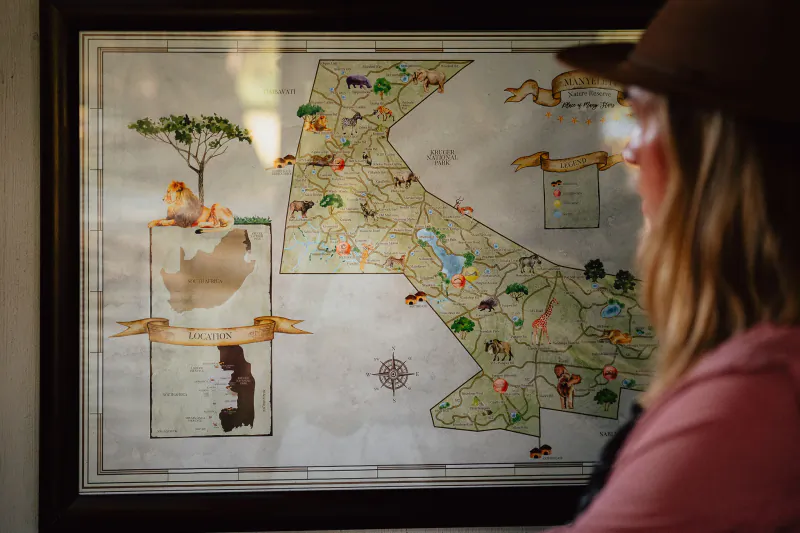
After the 1994 elections, the Manyeleti became the site of the first successful post-apartheid land claim in the region. It is now community-owned, managed by the Manyeleti Tourism and Parks Association on behalf of the people whose land it is. As our guide Reynard — who has worked across the Greater Kruger for long enough to speak about each landscape with the authority of someone who has read it carefully — pointed out one morning over the map: “The Manyeleti has the potential to be the best reserve in the world for sightings. The game movement here is unmatched.” The reserve sits at the narrowest point of the Greater Kruger, connecting Timbavati to Sabi Sand, funnelling game through in patterns that other reserves can only observe from a distance.
Six lodges, 24,000 hectares, vehicle density among the lowest in the Greater Kruger. What you trade in infrastructure, you gain entirely in space and silence and the feeling of being somewhere that hasn’t been smoothed into a product.
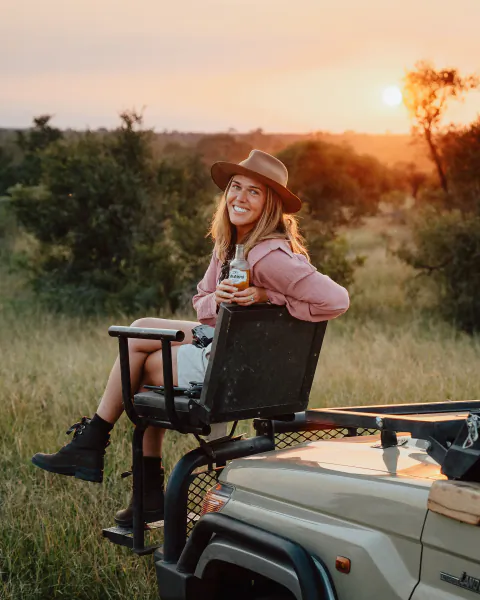
The morning drive on our first full day was, by any honest measure, an expedition.
The reserve had been through significant flooding in the weeks before our arrival and the roads reflected this in emphatic terms. Reynard navigated them with the calm of someone who has learned that the vehicle is considerably more capable than its passengers’ nervous systems suggest. We covered ground that in other conditions might have taken twenty minutes; that morning it took considerably more, and was considerably more interesting, and ended — as the best drives end — not at the lodge but somewhere else entirely.
Bush breakfast in the dry riverbed. Fires lit directly on the sandy floor, the smoke going straight up in the still air. Cast iron pans, hot coals, the smell of coffee and something cooking over an open flame. Every guest in camp that morning, alongside the guides, laughed when people who had just shared something slightly mad sat down in the open air and ate. Amarula in the coffee. Mimosas are appearing from somewhere. The riverbed was wide and pale around us, the kind of space that makes you feel both very small and very glad to be exactly where you are.
This, I kept thinking, is what people mean when they say they felt part of a place. Not welcomed into it. Part of it.
After breakfast, the hide.
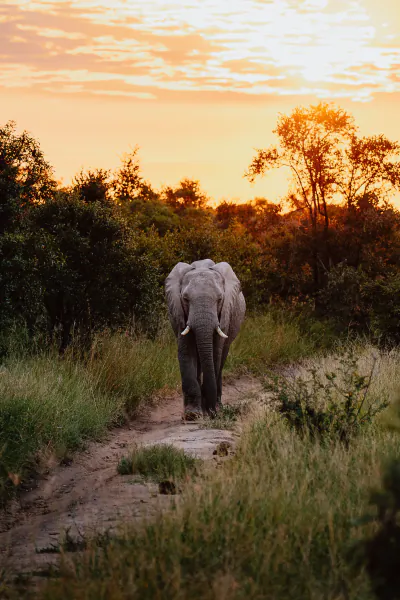
It sits just off the main veranda, above a waterhole that — in the aftermath of the floods — had run dry. This did not appear to concern the kingfisher, who had stationed himself on a branch above it and was diving down regardless, with the focused indifference of a professional who has decided the conditions are close enough. There is something specifically right about a kingfisher that refuses to adjust its expectations. Behind the hide, an elephant moved slowly through the treeline, pulling at branches, unhurried, entirely absorbed in the business of being an elephant. It did not look up.
There is no vehicle here, no commentary, no shared frequency with the rest of the reserve. You have to earn what you see — stop moving, stop reaching for your phone, stop composing the caption before the moment has finished happening. Just the dry waterhole, the kingfisher, the elephant in the trees, and the particular quality of silence that exists between one animal sound and the next.
I sat and watched and, for once, did not immediately begin writing sentences about it.
The Manyeleti teaches you how to look.
The afternoon put that lesson to immediate use.
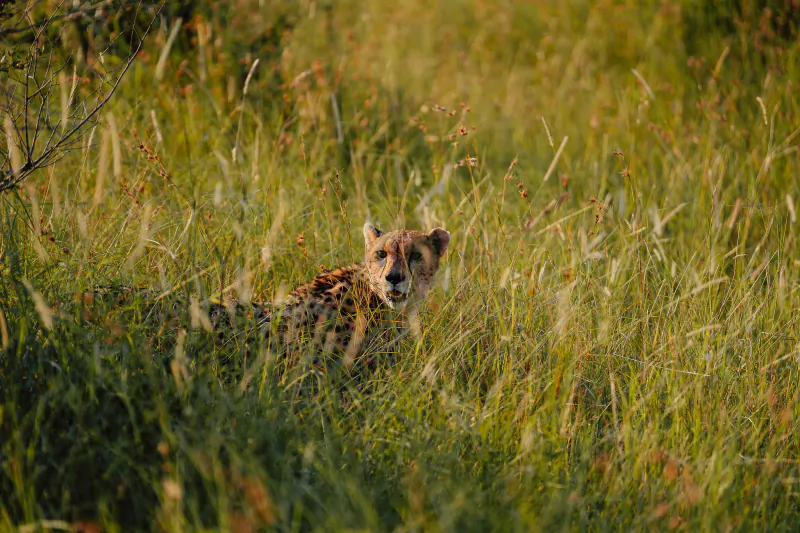
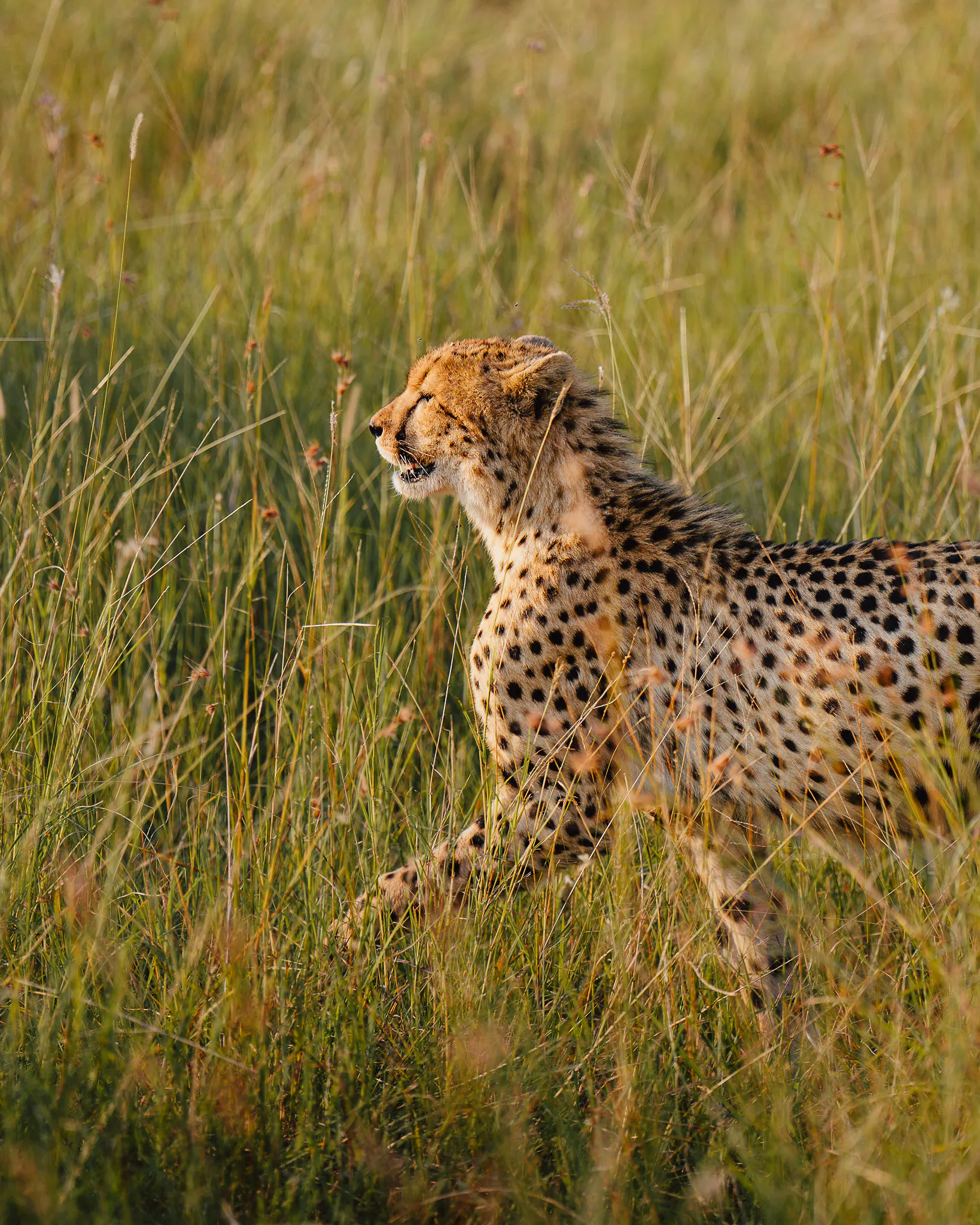
The cheetahs — four or five of them, the exact count part of the problem — had been located in the shade of a tree and by the time we arrived had decided to move into the long grass. Once a cheetah moves into long grass, you understand very quickly that your eyes are not the instruments you believed them to be. The spotted coat against dappled light. The long grass swallowed a shape whole. The quality of movement — fluid and then absolutely still and then simply gone — that makes you doubt what you thought you saw.
Everyone in the vehicle became, for that afternoon, an impromptu tracker — leaning forward, pointing at shapes that may or may not have been a flank, a tail, a shadow moving where shadows don’t usually move. Finding a cheetah and losing it. Finding it again somewhere else. Being told quietly that yes, there is one, right there — and looking and looking and finally seeing it, exactly where it had been all along.
The Manyeleti is famous for cheetah in a way that most reserves are not, and you understand why in the long grass, the low vehicle count and the sheer space of the place. It is a cheetah’s landscape first. The guiding philosophy here — allowing moments to unfold rather than chasing them — turns out to be the only approach that works.
The conservation work at Tintswalo happens mostly out of sight. This is, it turns out, entirely in keeping with the place.
Charles makes virtual safari content and documents the lodge’s operations for YouTube — bringing into view the work that most guests never witness and that Tintswalo has never felt the need to advertise. “The lodge does a lot of good,” he said. “It just doesn’t tell people.” He said it the way you’d describe something self-evident. A place that does this much without making noise about it is, if anything, more credible than one that leads with its conservation credentials.
What it does is specific and ongoing. Wire snares — set for subsistence hunting, indiscriminate in what they catch — require removal operations that can take days: locating the animal, baiting the area, waiting, darting, treating the wound, releasing, monitoring. Rhino de-horning is scheduled each winter across the Manyeleti, when cooler temperatures and lower vegetation make the work safer and the animals easier to locate from the air. Guests can join. Through Friends of Tintswalo — the collection’s non-profit initiative — contributions fund wildlife tracking, anti-poaching patrols, fence maintenance, veterinary support and emergency rescues across the reserve. Boots on the ground, every day, without a press release.
The Tintswalo Foundation spans the whole collection, but here, in the community reserve, it does some of its most intensive work.
Tintswalo Safari Lodge was the first property in the Tintswalo Collection, built twenty-five years ago around a single idea: that guests should feel not like visitors but like friends arriving at a private bush home. That philosophy shows up most clearly not in the design or the food or the suites — though all of those carry it — but in the people who stayed. Wise Mnisi came to Tintswalo in a different role, learned the bush day by day alongside experienced guides, qualified as a tracker and then as a full guide, and now runs sessions at a local tracking academy — opening for others the same doors that were once opened for him. Edwin Sibuyi helped build this lodge twenty-five years ago. He is the Maintenance Manager now. His wife works here. Several of his sons work here. The vision the family had when they broke ground is still here, walking around among the people who never left.
The kitchen garden supplies the lodge with herbs and seasonal greens; community-based projects in the surrounding areas handle the bulk produce, building supply chains that keep money in the local economy. The Abundant Village collaboration is working toward a self-sustaining community enterprise model that can extend to neighbouring communities over time. Solar transition is underway — infrastructure first, because reliability in a remote lodge cannot be compromised, and sustainability built on an unstable foundation helps no one. It is the honest position and the right one.
On the last evening, the note on the pillow again. Eden’s name. Her photograph. The wish for a good night.
The Manyeleti. Named, presumably, for the sky — and the sky here earns it, wide and dark and lit from horizon to horizon with the kind of clarity that city life makes you forget is possible. But I kept thinking about the name differently. A place of stars, in the sense of a place where things are made visible. The cheetah in the long grass, once you learn to look for it. The community that was told for decades it could not see this landscape, and that now owns it. The conservation work done in the dark, without headlines, with a dart gun and a wire cutter and the stubborn hope that the animal will survive. Your housekeeper, whose name is on your pillow.
Seeing is a skill. It requires patience and the willingness to be wrong before you find what you’re looking for. The Manyeleti taught me this in an afternoon with the cheetahs, and reminded me of it in every conversation I had while I was here.
Everything becomes visible, eventually, if you sit still long enough.
Image credits to Lochie Fuller Photography
On socials: @lochie.shoots
Written by Emma Blunt for Luxuria Lifestyle International