The Antipodean Itineraries Worth Planning a Year Ahead
Most luxury travel can be arranged in a season. A villa in Provence, a suite in Kyoto, a week in the Maldives. Six months of notice is generous, three is workable, and the truly well-connected can compress it further.
Australia and New Zealand do not behave this way, and the reason has nothing to do with availability. It is that the region’s finest experiences are governed by fixed natural calendars that no amount of influence will move.
Here is where the lead time genuinely earns itself.
The Windows That Cannot Be Negotiated
Consider the most striking example on the Australian coast.
Coral spawning on the Great Barrier Reef is a mass synchronised event in which entire colonies release their eggs and sperm simultaneously. According to the Reef Authority, the Australian government agency responsible for the Marine Park, it typically occurs one to six nights after the October, November and December full moons, with many corals relying on the moon’s light and gravitational pull to time it.
One to six nights. After a specific full moon. Once a year.
This is not a scheduling inconvenience to be delegated. It is an astronomical constraint, and it explains why the divers and photographers who witness it plan their travel around a lunar calendar rather than a holiday one.
The setting justifies the effort. The Great Barrier Reef is inscribed on the World Heritage List as a site of remarkable variety and beauty, managed as a multiple-use area under Australian federal and Queensland state jurisdiction.
The reef is available year-round. The reef doing the single most extraordinary thing it does is available for roughly a week.
Where Australia Luxury Cruises Justify the Lead Time
The second argument for early planning is structural rather than seasonal, and it concerns access.
Much of what makes this region exceptional sits along the coastline rather than inland: the Kimberley, the Tasmanian coast, the fiords of the South Island, the reef itself. Assembling that by road and domestic flight is possible but consumes the trip in logistics.
Silversea’s regional voyages address that directly, moving between Australian and New Zealand coastal destinations on a single itinerary rather than requiring the traveller to reassemble the journey at every stop. For a region this vast, the ship functions as the solution to the geography rather than merely as accommodation.
The lead time matters here for a specific reason. Suite inventory at this level is genuinely finite, seasonal sailings are limited, and the most desirable departures align with precisely the natural windows described above. Demand concentrates where the calendar allows, which is a narrow target.
Twelve months is not caution. It is arithmetic.
The Fiordland Argument
New Zealand’s case for early planning rests on scale and access rather than on a single unrepeatable event.
Te Wāhipounamu, the South West New Zealand World Heritage Area, encompasses 2.6 million hectares across four national parks, covering almost 10% of New Zealand’s total land area, according to the Department of Conservation. It contains rocks, plants and animals that trace back some 80 million years to when New Zealand formed part of the ancient supercontinent Gondwana.
Ten per cent of a country, held as protected wilderness. That is the order of magnitude a traveller is attempting to see, and it is not a day trip.
Its significance is formally recognised. The area was inscribed on the World Heritage List in 1990, and the previously separate Westland and Mount Cook and Fiordland listings were subsumed within it, reflecting the region’s glaciated landforms and ecological continuity.
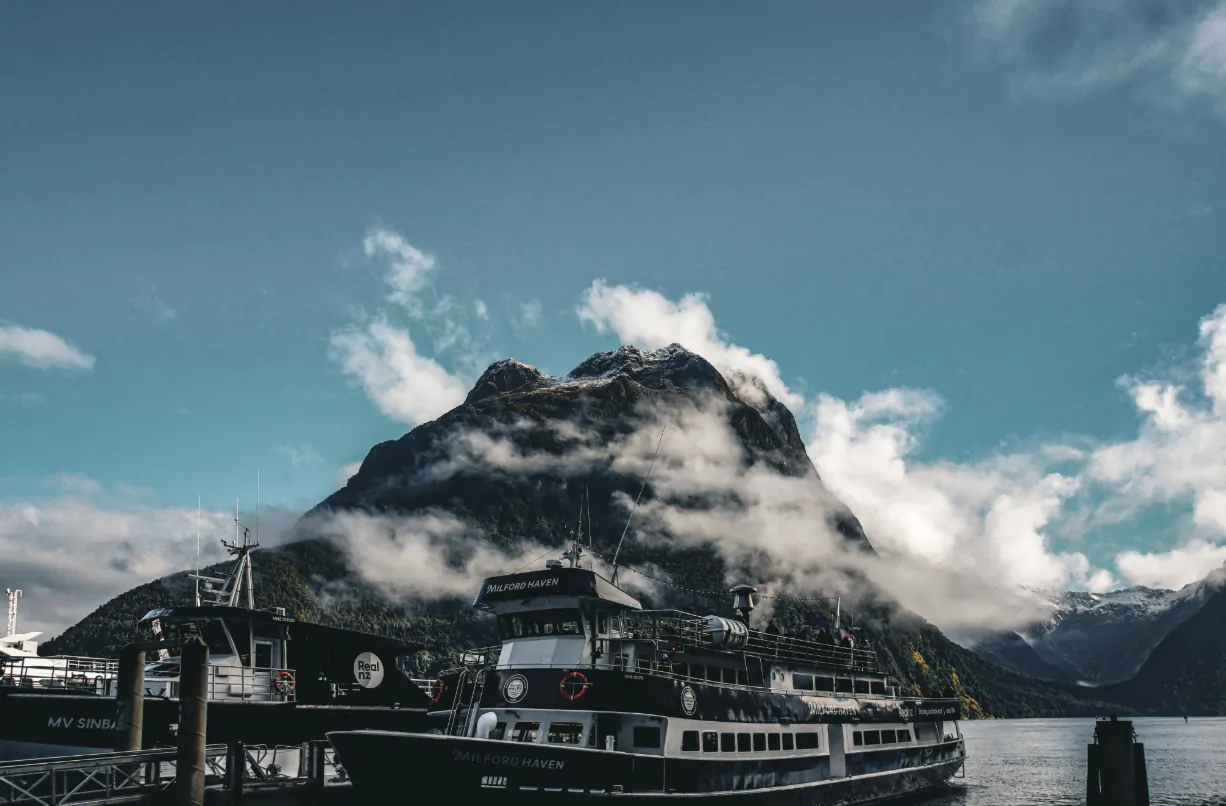
The practical implication is that Fiordland cannot be sampled casually. Access is limited, the weather is genuinely consequential rather than a matter of comfort, and the operators worth using are booked well ahead of the season. Arriving with a vague intention to see Milford Sound is how travellers end up viewing it through low cloud from a crowded vessel, having travelled eleven thousand miles for the privilege.
What Twelve Months Actually Purchases
Lead time in this region does not buy availability alone. It buys alignment, which is a considerably more valuable commodity.
It buys the ability to place a reef visit against a lunar calendar rather than a school holiday. It buys the suite category rather than whatever remains unclaimed. It buys shoulder-season conditions, which in this part of the world often means better light, fewer vessels on the water and more reliable wildlife encounters.
It also buys the option to combine. The Australian and New Zealand seasons overlap in a way that permits a single journey across both countries, but only if the planning begins early enough to secure the connecting elements while they still exist.
And it buys the least glamorous advantage of all, which is the ability to change one’s mind. A year of notice allows an itinerary to be revised twice without penalty or compromise. Three months of notice allows it only to be accepted as offered.
The Case for Beginning Now
There is a version of this region that can be experienced on short notice. It involves the well-trodden route, the standard vessel, and the reef on an ordinary Tuesday in an ordinary week, and it is perfectly pleasant. Travellers return home satisfied.
The version worth the journey from the northern hemisphere is the other one, and it is assembled rather than simply booked. Coral spawning does not reschedule itself for late arrivals. Fiordland does not expand its capacity to meet demand. The best suites on the best sailings in the best weeks are claimed by people who decided a year ago that they wanted them, and there is no mechanism by which that changes.
Antipodean travel rewards the planner more than almost any destination on earth, precisely because so much of what makes it extraordinary is governed by lunar cycles, weather systems and conservation limits that remain entirely indifferent to convenience or budget.
The itinerary worth having is the one begun long before anyone else starts looking.