The Rhino Whisperer – The man that’s saving Africa’s Black Rhino from extinction
Picket Chabwedzeka, Reserve Manager of Victoria Falls Private Game Reserve, is a big, barrel-chested man who keeps himself more or less in shape. Striding into the swanky lobby of the Stanley & Livingstone Boutique Hotel, he looks bulletproof, as if he owns the ground beneath his feet. He has the lean bearing and far-off gaze of a man whose world is the outdoors — a vastly experienced man of the bush.
The reserve he manages is an intensive protection zone for the endangered black rhino, and a conservation triumph. The reserve has a facility committed to ranger training, a dedicated Anti-Poaching Unit, a thriving rhino monitoring and breeding initiative, and a dehorning programme.
He condensed the backstory, which started in 1995 when the Stanley & Livingstone Boutique Hotel opened and erected an electric game fence around its 3,000-hectare perimeter. They immediately established a breeding programme, and over time — to keep the bloodlines pure — transferred some rhinos and brought others in.
Black rhinos have two horns, white rhinos have only one
“Wildlife management is not cheap!” exclaims Picket. “We are looking to relocate several and acquire one rhino bull. This will cost US$30,000, which involves darting via helicopter, crates, and transport to a park 100km away. It needs a highly trained game capture team — six people, plus a pilot, a vet, ground assistance, and a driver. Fifteen of my men will work on this. Then to capture and transport the new bull from Matopos National Park, 600km away, we need to do it all again. They need to translocate now as they are feeding on shrubs and grasses rather than tree foliage. These rhinos have had to adapt. White rhinos eat grass, but the black rhinos now eat grass too, and their necks have elongated — especially the founder members. This is due to years of picking up supplementary game nuts from feeding troughs.”
Picket explains the demanding and dangerous teamwork required in the dehorning process. Based on knowledge of their behaviour, his men identify which animals need to be dehorned and know where they are. They decide who gets dehorned first — usually the smart ones, as they may hide when it comes to their turn.
“On D-day, there is a team of rangers on the ground who closely monitor the movements of the rhino and send us GPS coordinates, which we pass onto the vet and pilot, who immediately get airborne in the helicopter.
The growling, gyrating sound of a chainsaw sends shivers up your spine
From the air, the vet darts the rhino. The ground team are on high alert as the rhino is now running with the chopper hovering above. The pilot, who guides the rhino to a safe accessible area where the team can perform the dehorning, radios the rangers on the ground, who rush to the location. As the tranquilliser kicks in, the ground team assists the collapsing rhino into a sitting position and folds in its front legs.
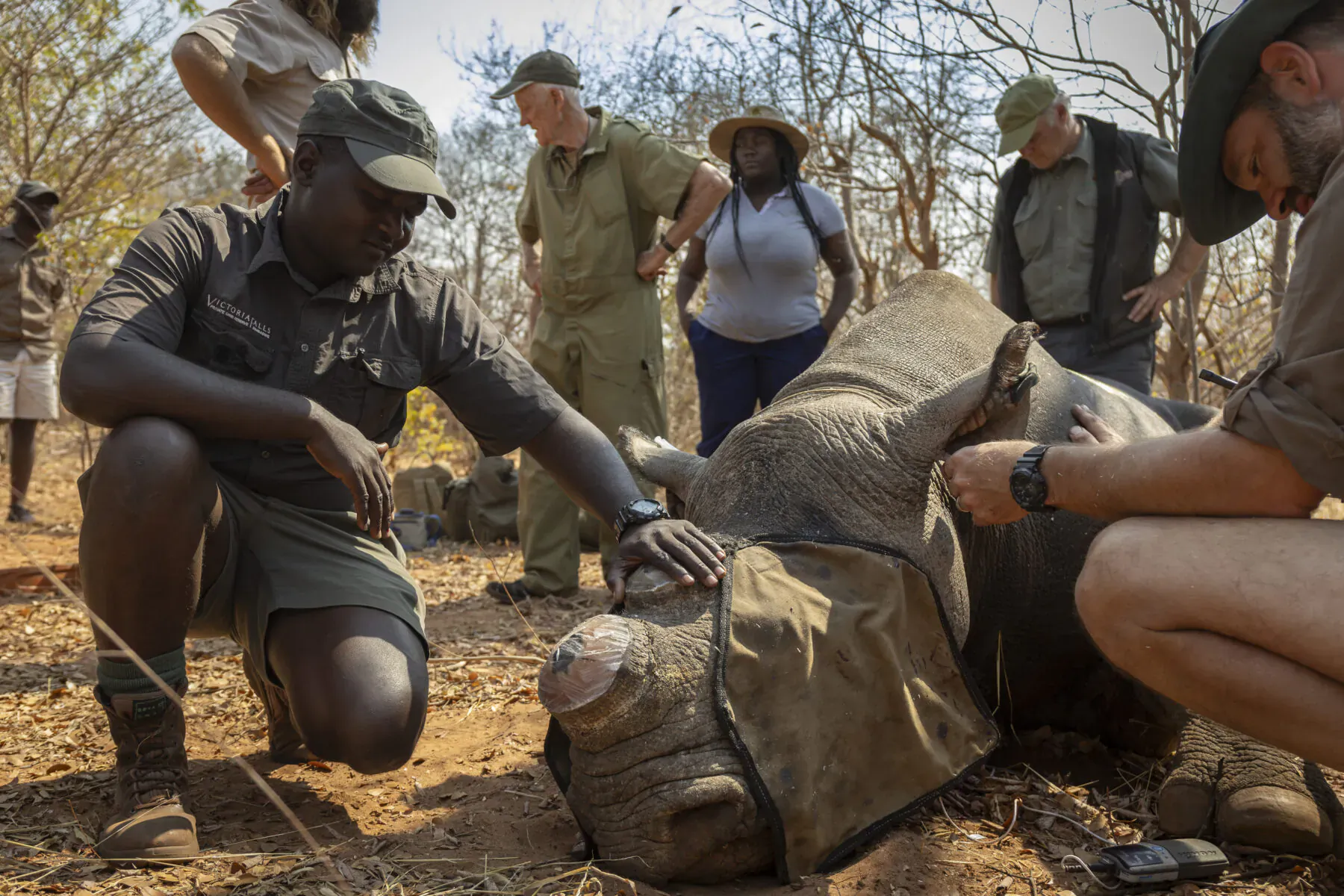
Then it’s all stations go, and everyone jumps into action, performing their critical tasks. A ranger sprays the rhino with water to keep it cool; another puts cotton wool into its ears; someone blindfolds the rhino; and three more place a sheet of canvas under its chin to collect the horn dust.
Armed rangers guard the scene while the vet moves in and measures the horns, calculating where to cut, and regularly checking the rhino’s oxygen levels and temperature. Moments later the chainsaw fires up. The vet, sitting on the rhino’s back, starts with the rear shorter horn, then moves onto the larger one in the front.
The rhino is now of no value to poachers
When the deed is done, a ranger marks the rhino’s back with orange water paint, signifying that it has been dehorned. The vet inserts a microchip between its shoulders and implants a transponder into the base of the stump for tracking purposes. The vet then administers the antidote for the rhino to wake up, and everyone gets clear.
Rhinos are state animals and require a police presence during the dehorning operation. The horns, the police, and National Park rangers then go to the National Parks Office where the horns are weighed — including the horn dust — and inventories completed. The horn is then transported to Harare where it’s locked away in the state vault.
The first dehorning occurs around the age of four, after which the growth rate quickens. Every three years the rhinos go through this procedure as the horns grow back.
“For me, it’s deeply personal. Dehorning at Victoria Falls signifies an 18-year legacy of zero poaching. I’ve been part of this mission for eight of those years. The threat to both rhinos and rangers is real. And it saddens me that we must dehorn these creatures for their survival, but I’m immensely grateful to everyone who made this project a success.”
Sometimes tranquillisers don’t work
Picket recalls a scary moment when a rhino woke halfway through the dehorning procedure, with the vet sitting on its back, chainsaw in hand. The rangers quickly tied the rhino down so the vet could complete the task.
“I know these animals. I can safely say there is no loss of any senses or social skills following dehorning. They still do ceremonial greetings by touching horns — but now they touch stumps. And when cows move their calves along (historically done using their horn), they use their stumps.”
Talking about budget, Picket says a large chunk of their funds come from tourism. Game drive fees contribute massively towards running the camp. “If there’s no money, I need to dip into my budget or drop something that needs to be fixed. Another big contributor is the Nakavango Conservation Programme (www.nakavango.com), our voluntourism working guest programme charging $820 per person per week for two weeks.”
Phil Eyles, a retired British police officer who spends three months a year in Africa on conservation projects, offers his perspective: “Working guest wildlife encounters are life-changing experiences. One day you’re working on a riverbed, packing rocks, then an elephant herd appears. You just sit quietly and watch. I’ve been hoodwinked into projects purporting to be about conservation, where you’re bottle-feeding lion cubs — it’s a shame, as once these cubs grow up, they become canned hunting statistics. My travels to Africa now centre on projects like this and how they impact the environment. I now see the wilderness differently.”
“A sizeable chunk of our income comes from wildlife trading,” says Picket. “Just recently we sold 150 buffalo to another reserve, which brought the numbers down to sixty within an area with a feeding capacity for 100. With the proceeds of this sale, we’re investing in eland, zebra, and more buffalo — bringing in a fresh bloodline.”
Poachers treed by a pride of lions
Recalling an amusing story, Picket speaks of an incident in 2013 when four armed poachers cut the fence and entered the reserve. Rangers discovered the damaged fence and tracked the poachers — later finding them trapped in a tree, held captive by a pride of lions waiting patiently below for armed backup. The poachers are still in prison.
I asked after his worst on-the-job experience. Picket removed his cap and wiped his brow with the back of his hand.
“We have a problem with a bull rhino who is fiercely territorial. This put his young calf in danger, so I took the youngster to my house for temporary safekeeping and enclosed him on my verandah. The bull found him, broke down the fence surrounding my house, and destroyed the verandah wall. The next morning, I found the calf’s body in the dam. He had been gouged and drowned. The bull’s second son was kept in a pen for four years and then moved to the Imire Reserve.”
Picket Chabwedzeka holds a degree in Geography and Environmental Management, a Master’s degree, and a post-graduate year at Oxford University in Ecological Survey Techniques. In 2016, he joined the Stanley and Livingstone Private Game Reserve as Anti-Poaching Manager. Five years on and he’s now Reserve Manager. He’s also involved in the management and training of anti-poaching rangers in numerous wildlife-protected areas in Zimbabwe.
Tracking is one of his many skills — he can track animals that passed by days before, touching the earth and sensing in his mind where they have gone. He shares this knowledge in the many ranger training courses he presents, believing that tracking is both a science and an art.
“Catching up with a tracked animal brings joy to the tracker. It is the ability to sharpen our refined senses and put our skills to the test — humans versus animals. It involves studying all the finer details of markings left on the ground.”
Once he has his helicopter pilot’s licence, Picket plans to pursue a PhD in his field.
W: Victoria Falls Private Game Reserve
Written by Cindy-Lou Dale for Luxuria Lifestyle International