What Greenville’s Finest Homes Have Underfoot
Facades lie, and rather often. A Colonial Revival portico can be added to almost anything, and across the Southeast it frequently was.
Floors are considerably more honest. What lies underfoot in a Greenville house tends to date the structure more reliably than anything visible from the street, because flooring reflects what was available, affordable and fashionable in a specific decade, and replacing it is expensive enough that most owners simply do not.
Walk the city’s historic districts and the material record reads chronologically.
The Antebellum Inheritance
The earliest surviving houses sit on something that cannot be replicated at any price.
Heart pine, milled from the dense inner heartwood of the longleaf pine, was the default structural and flooring timber across the antebellum South. The species once dominated vast stretches of the coastal plain and was logged extensively for timber and naval stores.
What makes the historic material distinct is age. Old-growth longleaf grew slowly, producing exceptionally tight growth rings and a high resin content that lends the wood density, hardness and a characteristic amber tone that deepens further with time.
Second-growth pine, harvested on modern rotations, is a different material wearing the same name. The rings are wider, the resin content lower, and the wear performance not comparable.
That is why reclaimed heart pine commands what it does. The supply is finite and consists almost entirely of timber salvaged from demolished buildings.
Greenville’s oldest designated district illustrates the period well. Hampton Pinckney, listed on the National Register in 1977, encompasses roughly thirty acres of Italianate, Queen Anne, Colonial Revival and Gothic Revival housing, much of it built when heart pine was simply what floors were made from.
What Hardwood Flooring Installation Greenville Homes Actually Demand
Here the conversation turns from history to physics, because the Upstate climate imposes conditions that determine whether any wood floor survives.
Greenville sits in a humid subtropical zone. Interior relative humidity swings substantially between a July afternoon and a January morning with heating running, and wood responds to that swing by expanding and contracting continuously.
This is why installation quality matters more than species selection in this market. Acclimation periods, subfloor moisture testing, correct expansion gaps at every perimeter and vertical obstruction, and appropriate fastening schedules are what separate a floor that performs for decades from one that cups by its second summer.
Firms working the local market understand this as routine rather than exceptional. 50Floor’s local installers operate across the Upstate, and the relevant question when commissioning any hardwood flooring installation Greenville homeowners are considering is not which species looks best in a showroom, but what moisture protocol the installer follows before a single board is laid.
In a period property, the stakes rise further. Original subfloors are rarely flat, joist spacing is often irregular, and crawlspace moisture is a variable that modern construction largely designs out.
The Craftsman Turn
Move into the neighbourhoods built around the turn of the century and the flooring changes character.
The Pettigru Street Historic District contains 88 structures built between 1890 and 1930, with the majority raised between 1910 and 1930. That window corresponds precisely to the American Craftsman period and its Colonial Revival contemporaries.
Flooring in these houses is typically narrower than the antebellum boards, more consistently milled, and increasingly oak rather than pine as national distribution networks matured and hardwood became affordable outside its growing regions.
The Craftsman ethic favoured visible material honesty, so floors were finished to show grain rather than obscured under carpet or paint. Quarter-sawn oak, with its distinctive medullary ray figure, belongs to this era and remains among the most quietly expensive things a house can have underfoot.
The Interwar Estates
The next stratum is the most architecturally ambitious.
The East Park Historic District, documented by the South Carolina Department of Archives and History, comprises 121 contributing buildings constructed between 1908 and 1950 in a planned suburban community a short distance from downtown, with Tudor Revival, Colonial Revival and Neo-Classical styles predominating.
Houses of this period introduce the decorative floor. Herringbone and chevron patterns, contrasting border inlays, and parquet in formal rooms appear where budgets allowed, alongside stone and tile in entrance halls intended to impress before a guest reached the drawing room.
These are also, unfortunately, the floors most frequently damaged by mid-century modernisation, when wall-to-wall carpet was installed over perfectly sound hardwood and, in the worst instances, adhered directly to it with mastic that no restoration process fully removes.
What the Current Market Actually Chooses
Contemporary Greenville buyers restoring or building at the upper end are converging on a fairly consistent set of choices.
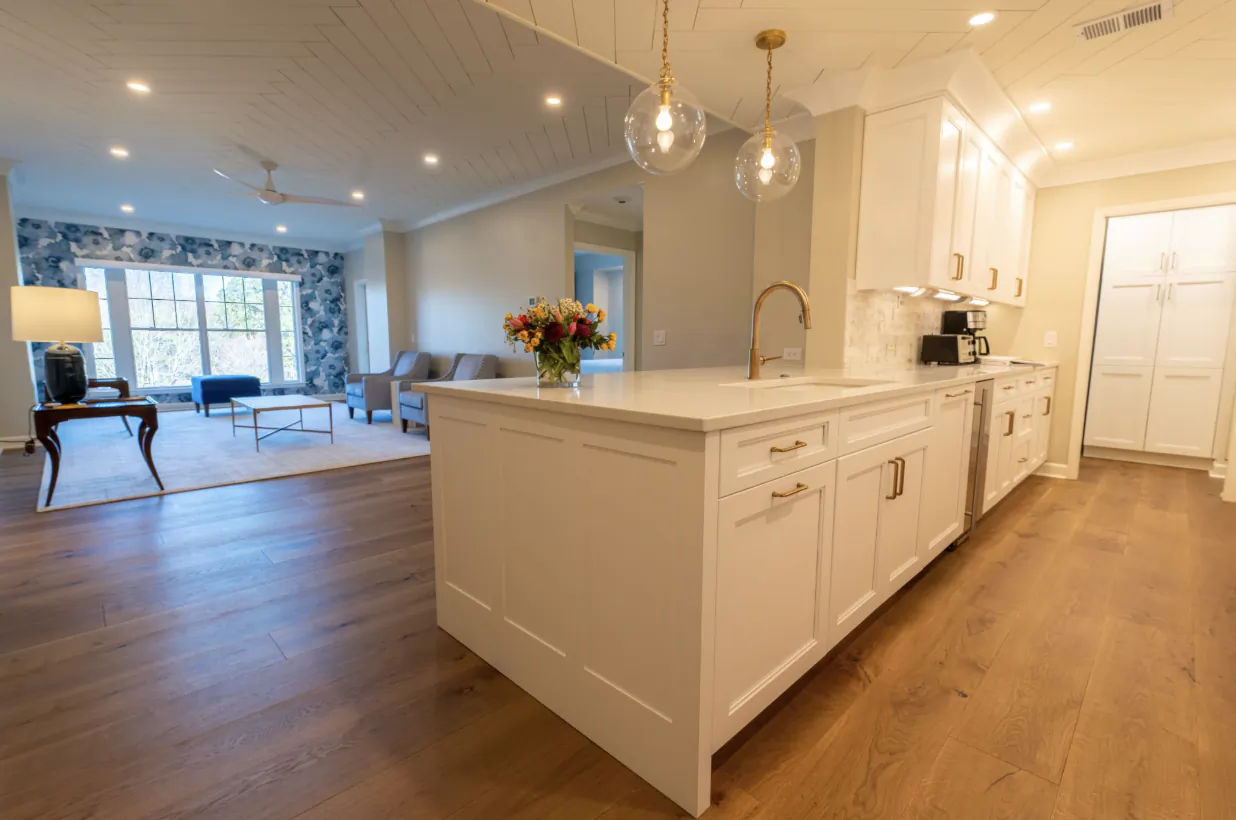
Wide-plank white oak dominates, in matte or oiled finishes rather than the high-gloss polyurethane that defined the 1990s. Engineered constructions are increasingly specified over solid boards, and not as a compromise: a properly built engineered floor, with a multi-ply core running perpendicular to the wear layer, is dimensionally more stable in a humid climate than solid timber of the same species.
Reclaimed heart pine remains the prestige option in restoration work, precisely because it is the only way to genuinely match what was originally there rather than approximate it.
And grey-toned finishes, ubiquitous a decade ago, have receded almost entirely in favour of warmer and more natural tones, which is a reversion rather than an innovation.
The Point
A house in one of Greenville’s historic districts carries a material history that is entirely legible to anyone who knows what to look for, and almost completely invisible to everyone else.
Heart pine means one thing. Quarter-sawn oak means another. A herringbone parquet laid in a formal room means a particular decade and a particular budget, and the two are rarely separable.
What the finest of these houses have underfoot is rarely the most expensive material available on the market. It is the correct material, installed properly, for a climate that punishes shortcuts within a season or two of the work being finished.