When the Exterior Becomes the Signature of a Luxury Property
The property makes its first argument before anyone reaches the door.
A driveway that descends between old trees and holds the building until the last possible moment. A stone façade whose weight is legible from a distance, communicating something about permanence before a single material is named. A terrace where the pool appears to meet the sea — not a swimming pool with a view but a deliberate compositional choice that makes water continuous across different scales. These things register before the conscious mind processes them.
The exterior’s job, in a property at this level, is not to protect the building. It’s to begin the story.
What the Exterior Is Actually Saying
A luxury exterior can communicate calm retreat or quiet drama. Mediterranean warmth or northern restraint. Genuine privacy — the kind that feels like a deliberate gift, not a security response. Sometimes several of these at once.
What it should not communicate is ambiguity.
The properties that stay in the memory are the ones whose exteriors made a clear architectural argument. A stone villa where the building appears to have grown from the hillside rather than been placed on it. A penthouse building whose glazed corner frames a city skyline as deliberately as a composition. A coastal estate where the architecture and the water are in conversation. Not loud, not insistent — but specific.
When the Building Doesn’t Exist Yet
Almost every luxury project has the same problem: the exterior needs to be understood before the building can be experienced.
Owners, architects, landscape designers, sales teams — they all need to be working from the same vision. How the façade reads from the arrival point. How stone or timber looks in the local light across different hours. How the terrace relates to the surrounding landscape. How does the building change as you approach it from a distance? None of this is visible from a floor plan.
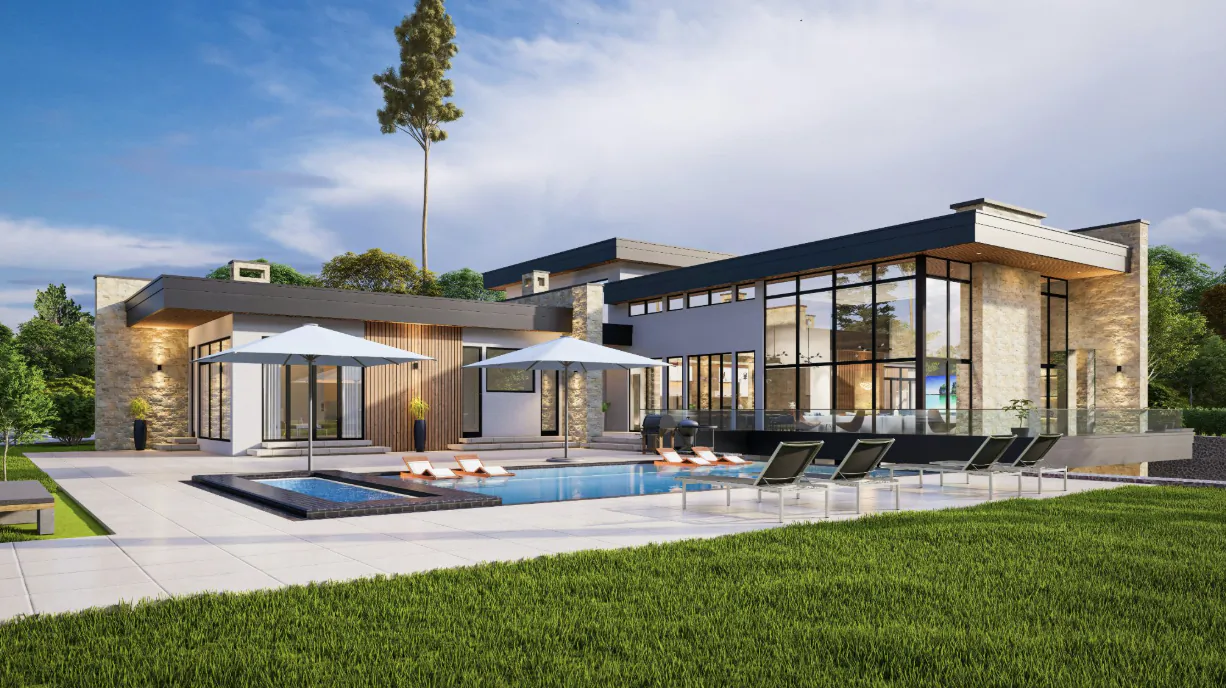
Before a villa, resort, or branded residence is complete, its exterior identity has to be understood by owners, designers, investors, and future buyers. At that stage, a 3D exterior rendering company can help communicate the relationship between architecture, materials, landscape, light, and arrival experience before the property physically exists. This is where many of the most consequential decisions about the property’s character get made — not at the marketing stage, but here, while the choices are still relatively free.
Materials Before Details
The material palette tells most of the story before anything else is absorbed.
Stone implies permanence. A connection to the ground it sits on, a resistance to being hurried. Timber brings warmth — the sense that someone cared about craft, not just specification. Glass offers deliberate ambiguity about where the building ends and the landscape begins. These aren’t neutral choices. They’re the first sentences of the exterior’s argument.
The finest luxury exteriors tend to use a limited palette and handle each material with genuine precision. The thickness of a stone coping. The profile of a timber screen catching afternoon light. The relationship between a glazed wall and the terrace below it. These details operate below conscious awareness and they are exactly what separates a building that feels expensive from one that feels exceptional.
The specific also matters. Mediterranean architecture draws on textured plaster and warm tile that have belonged to that landscape for centuries. Dark timber and pale stone in northern contemporary design produce a quality of restraint that’s particular to that setting. An exterior that belongs to its place feels different — more resolved, more inevitable — than one that could have been built anywhere.
Credibility Is the Standard
For luxury properties marketed before completion, an impressive image that reads as slightly false will not hold the attention of a sophisticated buyer.
Where proportions are subtly wrong. Where shadows behave differently from how they would in reality. Where the surrounding landscape feels generic rather than specific to that site. Buyers at this level are experienced enough to feel the difference between something that has been accurately modelled and something that has been optimistically rendered.
A realistic architecture render should do more than show an attractive building. It should make stone, timber, glass, planting, scale, shadows, and the surrounding context feel believable enough for viewers to judge the property’s character with confidence. Accuracy in how light behaves on different materials at different hours, in how the surrounding landscape is represented, in the proportions of the architecture: for luxury projects where the exterior is the primary promise, this is the baseline, not an aspiration.
The Landscape Doesn’t Stop at the Building’s Edge
The exterior continues into the landscape — how gardens, terraces, pools, and planted boundaries relate to the architecture.
The infinity pool extends the horizon rather than interrupting it. A courtyard garden that creates shade and calm within a coastal landscape. An avenue of planting that marks the arrival route and delays the reveal of the building. A terrace where the dining position was chosen because of how the light falls there in the evening and how the wind behaves from that direction in summer.
These are simultaneously architectural and horticultural decisions, and they require the same intention as any element of the interior. The properties that feel most resolved are almost always the ones where building and landscape appear to have been conceived together — each making the other more legible.
Privacy Without Enclosure
Luxury buyers consistently rate privacy among their highest priorities. The exterior is where that privacy is either designed into the property or left to chance.
A long approach road creates psychological separation before the building is visible. Dense planting screens neighbouring properties while the garden still feels open and generous. A recessed entrance that’s difficult to observe from the road without producing the impression of a defensive structure. Layered thresholds — a gate, then a courtyard, then an entrance — that let the property open toward guests while remaining closed to the world beyond.
Done well, none of this reads as a security decision. The screening looks like landscaping. The orientation looks like a response to the view. The threshold sequence feels ceremonial rather than cautious.
After Dark
A luxury exterior that works only in daylight is an incomplete design.
Architectural lighting transforms the evening character of a property in ways that are hard to anticipate without intending them. A façade wash that illuminates the texture of stone — suddenly the material that read as cool in afternoon light becomes warm and particular. Pool lighting that makes the water glow in the dark landscape. Pathway lighting that marks the route through a garden without competing with the sky. An entrance lit from below, creating the sense that the building rises from its foundation.
Some properties are at their most compelling in this hour — when the architecture softens and the light becomes the primary material.
Belonging to a Place
A coastal estate in Mallorca and a countryside manor in England might share the same commitment to arrival sequence and material quality and still speak entirely different architectural languages. They should.
The most admired luxury architecture responds to its specific setting. To the quality of local light, which changes not just seasonally but within hours in ways that are particular to each latitude and landscape. To the traditional materials of the region. How buildings in that place have always addressed the ground and the sky.
When all of it works together — architecture, materials, landscape, light, arrival, privacy — and when everything reads as specific to that site rather than generic to a category of luxury, the exterior stops being a façade. It becomes the thing people try to describe when they explain why a property stayed with them.